
TL;DR:
- In New Jersey, renovation inspections ensure work meets safety and code standards before progressing. Homeowners must follow a strict, sequential process with licensed contractors to pass inspections and avoid penalties. Proper preparation and early communication with local officials help ensure a smooth project and legal compliance.
Renovation inspections in New Jersey are formal reviews required under the New Jersey Uniform Construction Code (UCC) to confirm that home improvement work meets safety, structural, and code compliance standards before the next phase of construction begins. The New Jersey Department of Community Affairs (DCA) oversees this system, while local Construction Officials enforce it at the municipal level. Understanding how renovation inspections work in NJ protects your investment, keeps your project legal, and prevents costly surprises at resale. Every homeowner planning a significant improvement should know this process before breaking ground.
How renovation inspections work in NJ: the core framework
Building permits and inspections exist to enforce minimum building standards covering structural safety, fire protection, wiring, and plumbing. That means every inspection is a checkpoint, not a formality. The UCC creates a sequential system where each phase of work must pass review before the next phase starts. Skipping a step is not an option under New Jersey law.
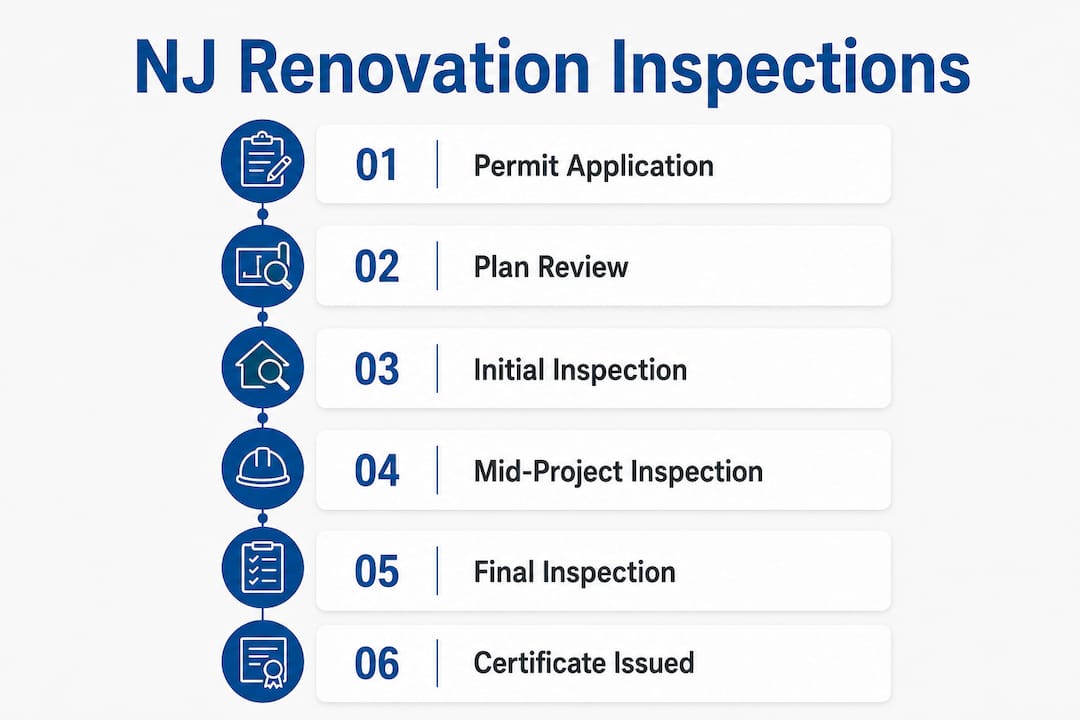
The process begins when you or your contractor submits a permit application to your local building department. A plan reviewer examines the drawings and specifications for code compliance. Once the permit is approved, work can start, and inspections are scheduled at defined milestones throughout the project.
Which home renovations require permits and inspections in NJ?
Not every project triggers a permit, but the list is longer than most homeowners expect. Many NJ municipalities require permits for the following types of work:
- Structural changes, additions, and room conversions
- Electrical upgrades, panel replacements, and new circuits
- Plumbing fixture changes, pipe rerouting, and water heater replacements
- HVAC installations, duct modifications, and new equipment
- Decks, porches, and attached structures
- Finished basements and attic conversions
Interior finish work like flooring, painting, and cabinet replacement typically does not require a permit. The key distinction is whether the work affects structural, mechanical, or life-safety systems.
Permit requirements vary by municipality. What Monmouth County requires may differ from what Ocean County mandates. Always confirm with your local building department before starting any project.
Pro Tip: Call your municipal building department before hiring a contractor. Ask specifically whether your planned scope requires a permit. Get the answer in writing or by email so you have a record.
The consequences of skipping permits are severe. Unpermitted work can trigger insurance claim denials, expensive fines, or forced demolition of non-compliant construction. Buyers’ attorneys routinely check permit history during real estate transactions, and undisclosed unpermitted work can kill a sale or expose you to legal liability.
What are the inspection stages during a NJ home renovation?
The NJ UCC mandates a sequential inspection process that moves from the ground up. Each stage must pass before the next begins. Here is the standard order for most residential renovation projects:
- Permit application and plan review. Submit drawings, specifications, and the permit application to your local Construction Official. The reviewer checks for UCC compliance before issuing the permit.
- Footing and foundation inspection. The inspector verifies excavation depth, footing dimensions, and reinforcement before concrete is poured.
- Rough framing inspection. Structural members, headers, and load-bearing elements are reviewed before walls are closed.
- Rough mechanical inspections. Electrical, plumbing, and HVAC rough work is inspected while systems are still exposed. Inspectors verify hidden safety elements like internal wiring, plumbing connections, fire blocking, and load-bearing structures that cannot be checked after walls close.
- Insulation inspection. Thermal and fire-rated insulation is reviewed before drywall installation.
- Final inspection. All systems are tested in their finished state. The inspector confirms the work matches the approved plans.
- Certificate of Occupancy or Certificate of Approval. A Certificate of Occupancy (CO) is issued for new structures or additions. A Certificate of Approval (CA) covers alterations to existing spaces. Neither is issued until every inspection passes.
| Inspection stage | What the inspector checks |
|---|---|
| Footing and foundation | Depth, dimensions, rebar placement before pour |
| Rough framing | Structural members, headers, load paths |
| Rough mechanical | Wiring, pipes, ducts, fire blocking |
| Insulation | Thermal values, fire-rated assemblies |
| Final | Finished systems, fixtures, code compliance |
Inspections must be performed within three business days of the request. That timeline matters because no work can legally proceed without passing the required inspection. Plan your project schedule around these milestones to avoid costly downtime.
Failed inspections require corrections and re-inspections, which add both cost and time to your project. Passing each stage on the first attempt is the most efficient path to completion.
How to prepare for renovation inspections in NJ
Preparation is the single biggest factor in passing inspections on the first attempt. Homeowners who understand what inspectors look for avoid the most common failure points.
Licensed contractors generally handle permit applications, schedule inspections, and manage code compliance. Hiring a licensed contractor removes most of the administrative burden from you. Verify your contractor’s license through the New Jersey Division of Consumer Affairs before signing any contract. You can review a licensed contractor checklist to know exactly what credentials to confirm.
Key preparation steps include:
- Keep all approved permit documents on site during construction. Inspectors will ask to see them.
- Do not close walls, pour concrete, or cover any rough work before the relevant inspection passes.
- Schedule inspections as soon as each phase is ready. Waiting adds unnecessary delays.
- Document your own work with photos at each stage. This creates a record if questions arise later.
- Confirm that your contractor’s subcontractors are also licensed for their respective trades.
Pro Tip: Ask your contractor to walk you through the inspection schedule at the project kickoff meeting. Knowing the exact sequence prevents surprises and keeps everyone accountable.
The role of building surveyors in home renovations mirrors what NJ Construction Officials do locally. Understanding their authority helps you communicate more effectively during the process. Inspectors are not adversaries. They are there to confirm the work is safe, and a well-prepared site makes their job straightforward.
Who are the inspectors and what authority do they hold in NJ?
New Jersey’s inspection system involves multiple officials, each with a distinct area of authority. The Construction Official leads the local enforcement agency and coordinates all subcode officials. Subcode officials inspect their respective disciplines independently, covering building, electrical, plumbing, and fire protection.
Approximately 36 NJ municipalities use direct state enforcement through the DCA rather than local construction officials. In those towns, the state handles permit review and inspections directly. The process is similar, but contact points differ. Confirm which enforcement structure applies in your municipality before submitting your permit application.
“Inspectors have the authority to issue stop-work orders when construction proceeds without required permits or fails to meet code standards. A stop-work order halts all activity on the site until violations are corrected and re-inspected. Homeowners can appeal decisions through the Construction Board of Appeals, but that process takes time and money. The far better path is compliance from the start.”
If you receive a failed inspection notice, address every cited item before requesting a re-inspection. Partial corrections lead to repeat failures and compounding delays.
Common challenges when navigating NJ renovation inspections
Even well-planned projects run into inspection complications. Knowing the most common problems in advance lets you sidestep them.
- Unpermitted work discovered mid-project. If an inspector finds work done without a permit, stop-work orders, project delays, and retroactive permits become the immediate reality. Retroactive permits often require demolishing finished work to expose what was built.
- Scheduling gaps. Contractors who fail to schedule inspections promptly create idle time on site. Build inspection windows into your project timeline from day one.
- Incomplete documentation. Missing approved plans, contractor licenses, or subcontractor credentials slow inspections and raise red flags.
- Changes to approved plans. Any scope change after permit approval requires a plan amendment. Making unapproved changes is one of the fastest ways to trigger a stop-work order.
- Historic or complex homes. Older properties in Monmouth and Ocean County often have non-standard construction. Pre-construction meetings with your local building department clarify requirements before work starts and prevent mid-project surprises.
Early communication with your local building department is the most underused tool available to homeowners. A 30-minute conversation before you finalize plans can save weeks of rework. Review a renovation contracts checklist to confirm your contractor’s agreement covers permit responsibilities clearly.
Key Takeaways
NJ renovation inspections follow a mandatory sequential process under the UCC, and passing each stage on the first attempt requires licensed contractors, complete documentation, and early coordination with local officials.
| Point | Details |
|---|---|
| Permits trigger inspections | Structural, electrical, plumbing, and HVAC work all require permits and inspections in NJ. |
| Sequential process is law | Each inspection stage must pass before the next phase of work begins under the UCC. |
| Inspectors check hidden work | Rough mechanical inspections verify wiring, pipes, and fire blocking before walls close. |
| Licensed contractors reduce risk | Professionals handle permit applications and inspection scheduling, reducing homeowner burden. |
| Skipping permits costs more | Unpermitted work leads to fines, insurance denials, stop-work orders, and forced demolition. |
What I’ve learned from watching NJ homeowners navigate inspections
The inspection stage that catches the most homeowners off guard is the rough mechanical. Walls look ready to close, the project feels like it’s moving, and then the inspection reveals a plumbing slope that’s off or a missing fire block. Work stops. Drywall gets pushed back a week. The contractor scrambles. I’ve seen this pattern repeat on projects where the homeowner assumed the contractor had everything handled without ever asking for a schedule.
The permit process protects your home’s long-term value in ways that aren’t obvious until you try to sell. Buyers in Monmouth and Ocean County are sophisticated. Their attorneys pull permit histories. A kitchen remodel done without a permit is a negotiating liability, not an asset. The cost of doing it right the first time is always lower than the cost of fixing it later.
My honest advice: hire a contractor who treats permits as part of the job, not an inconvenience. At Rockenterprisecontracting, the owner is on site personally, which means permit coordination and inspection readiness are never delegated to someone who doesn’t understand the stakes. That hands-on approach is what separates a smooth project from a stalled one.
— ryan
Rockenterprisecontracting handles NJ permits and inspections for you
Coordinating permits and inspections while managing a renovation is a full-time job on top of your actual life. Rockenterprisecontracting takes that weight off your shoulders entirely.

As a licensed, family-owned contractor serving Monmouth and Ocean County, Rockenterprisecontracting manages every permit application, schedules all required inspections, and keeps your project moving through each UCC milestone. The owner personally oversees every project, which means nothing falls through the cracks. Browse the renovation services available to see how the team handles kitchen remodels, bathroom renovations, and tile work from permit to final inspection. Ready to start? View completed projects and contact Rockenterprisecontracting for a personalized consultation.
FAQ
What renovations require a permit in NJ?
Additions, decks, electrical upgrades, plumbing changes, and HVAC work all require permits in most NJ municipalities. Interior finish work like flooring and painting typically does not.
How long does a NJ renovation inspection take to schedule?
NJ law requires inspections to be performed within three business days of the request. Scheduling promptly after each phase is complete keeps your project on track.
What happens if you renovate without a permit in NJ?
Skipping permits can result in stop-work orders, fines, insurance claim denials, and forced demolition of non-compliant work. Retroactive permits often require exposing finished construction for review.
What is a Certificate of Occupancy in NJ?
A Certificate of Occupancy (CO) is issued after all inspections pass for a new structure or addition. A Certificate of Approval (CA) covers alterations to existing spaces. Neither is issued until every required inspection is complete.
Can a homeowner pull their own permits in NJ?
Homeowners can apply for permits on their own property in most NJ municipalities. However, licensed contractors typically manage this process and carry the legal responsibility for code compliance on the work they perform.