
TL;DR:
- Contractor registration in New Jersey shores requires continuous renewal, bonding, and insurance to protect homeowners from unqualified operators. enforcement actions in 2025 demonstrate that non-compliance leads to significant penalties, project delays, and legal risks. Verifying active registration and documentation before and during a project is essential for legal protection and successful home renovation.
Contractor licensing in New Jersey shore towns is a mandatory registration and bonding process that protects homeowners and investors from unqualified contractors, financial loss, and legal exposure. The term “licensing” is used loosely in everyday conversation, but the precise legal term in New Jersey is registration under the NJ Division of Consumer Affairs. Understanding this distinction is the first step toward protecting your renovation investment. Recent 2025 enforcement actions in Ocean County confirm that the state takes contractor registration seriously, and the consequences for homeowners who skip verification can be severe.
Why contractor licensing matters in NJ shore towns
New Jersey’s regulatory framework for home improvement contractors is governed by two statutes: the Contractors’ Business Registration Act and the Home Improvement Contractor Licensing Act. Both require any contractor performing home improvement work valued over $500 to maintain active registration with the NJ Division of Consumer Affairs. Registration is not a one-time event. It requires annual renewal, proof of insurance, and a compliance bond held continuously throughout the registration period.
The 2024 amendments to the Contractors’ Business Registration Act tightened these rules further. Contractors must now maintain compliance bonds or securities issued by sureties authorized in New Jersey for the entire registration period. This means a bond that lapses mid-project puts the contractor out of compliance, even if the original registration was valid at the start.
Here is what the law requires from every registered home improvement contractor in New Jersey:
- Active registration with the NJ Division of Consumer Affairs, renewed before expiration (many registrations expired March 31, 2025, making timely renewal critical to avoid penalties)
- A compliance bond or acceptable alternative security, such as an irrevocable letter of credit, maintained without interruption
- General liability insurance at a minimum of $500,000 and workers compensation coverage if employees are present
- A written contract for any job over $500, with the contractor’s DCA registration number displayed on all estimates, contracts, and written communications
- Right-to-cancel language and other consumer disclosures required under NJ law
Pro Tip: Before signing any contract, search the contractor’s name or registration number directly on the NJ Division of Consumer Affairs website. A contractor can hand you a registration number that expired last month. Verification takes two minutes and can save you thousands.
How does licensing enforcement affect shore town homeowners?
The state does not rely on complaints alone to catch unregistered contractors. In late 2025, the NJ Division of Consumer Affairs conducted Operation Safe House in Manchester Township, an undercover sting that targeted home improvement contractors working without current registrations. Eighteen contractors received Notices of Violation and $2,500 civil penalties each. That figure represents the per-violation fine, and multiple violations can stack.
What makes this enforcement action significant for homeowners is the target profile. These were not fly-by-night operators. Many had lapsed registrations, meaning they were previously registered but failed to renew. A contractor who was legitimate last year may not be compliant today.
The practical risks to you as a homeowner or investor include:
- Project delays if a contractor is cited mid-project and forced to stop work
- Financial loss with no bond in place to cover incomplete or defective work
- Legal vulnerability if the contract itself is challenged due to the contractor’s non-compliant status
- Permit complications since municipal building departments in shore towns like Sea Bright and Rumson cross-check contractor registration status
“Contractor licensing is not just permission to work. It is a legal protection scaffold for homeowners against fraud, faulty work, and financial risk in New Jersey.” — NJ Contractor Lawsuit Protection, Peter J. Lamont, Esq.
Verifying registration before hiring is not optional due diligence. It is the single most effective action you can take before a contractor sets foot on your property.
What legal risks come with hiring an unlicensed contractor?

The legal consequences of hiring an unregistered contractor extend well beyond a failed inspection. New Jersey law requires the DCA registration number on every written contract, estimate, and communication. If that number is missing or expired, the contract itself becomes legally vulnerable. Under New Jersey’s Consumer Fraud Act, violations by contractors can expose them to treble damages, meaning a court can award you three times your actual losses plus attorney fees.
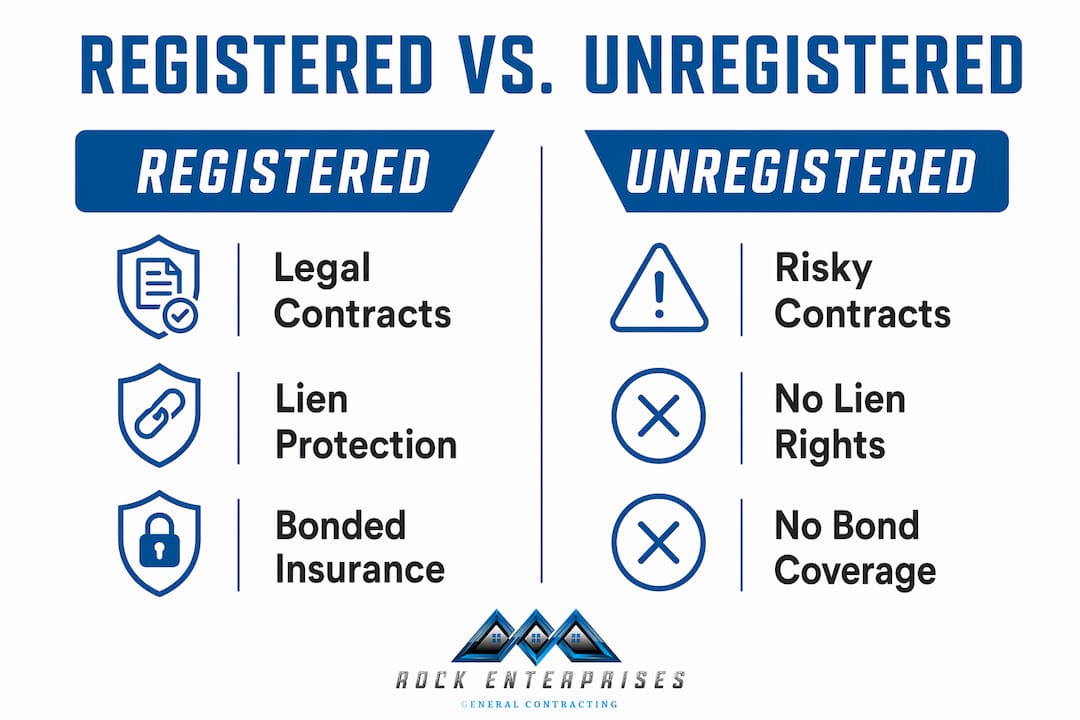
The comparison below shows the difference between working with a registered versus unregistered contractor across the dimensions that matter most to property owners:
| Factor | Registered contractor | Unregistered contractor |
|---|---|---|
| Contract enforceability | Legally valid, DCA number present | Potentially void or challengeable |
| Consumer Fraud Act protection | Full treble damages available | Limited or no recourse |
| Lien rights on property | Contractor can file valid lien | Lien rights may be denied by courts |
| Bond coverage | Active bond protects homeowner | No financial guarantee |
| Insurance verification | Minimum $500,000 liability confirmed | Unknown or unverified |
Lien rights deserve special attention for investors and anyone planning to sell or refinance. New Jersey courts deny construction lien claims when a contractor’s DCA registration was not current during the period of work. This sounds like a contractor problem, but it becomes your problem fast. An unregistered contractor who files a lien anyway creates a title defect that can delay or kill a sale or refinance until the dispute is resolved.
Pro Tip: Ask your contractor for a copy of their current DCA registration certificate and their bond documentation before work begins. A legitimate contractor will provide both without hesitation. Resistance to this request is itself a red flag.
How do bonding and insurance requirements protect shore town property owners?
A compliance bond is a financial guarantee backed by a licensed surety company. If a contractor violates state regulations or fails to fulfill contractual obligations, the bond provides a fund from which homeowners can seek compensation. This is distinct from general liability insurance, which covers physical damage and injury. Both are required, and both serve different protective functions.
The compliance bond requirement introduced in the 2024 amendments means that contractors must maintain this bond for the entire registration period, not just at the time of renewal. A contractor whose bond lapses in October, even if their registration runs through March, is out of compliance. Shore town homeowners running renovation projects through the off-season should confirm bond status at project start, not just at contract signing.
General liability insurance at the $500,000 minimum protects you if a worker damages your property or a third party is injured on site. Workers compensation coverage protects you from liability if an employee is injured while working on your home. Without these coverages, you could face a lawsuit from an injured worker even though you are the homeowner, not the employer.
The practical benefits of bonding and insurance for shore town property owners break down as follows:
- Compliance bonds provide direct financial recourse if the contractor abandons the project or violates regulations
- General liability insurance covers property damage caused by the contractor’s work or crew
- Workers compensation removes your exposure to injury claims from contractor employees
- Bond continuity confirms the contractor is financially stable enough to secure surety backing throughout the project
Shore towns like Wall Township, Oceanport, and Hazlet see significant renovation activity, particularly after storm seasons. In high-demand periods, some contractors cut corners on renewals to keep costs down. Verifying bond and insurance status directly with the issuing surety or insurer, not just by asking the contractor, closes that gap.
Key takeaways
Contractor registration in New Jersey is a continuous legal obligation, and verifying active status before and during your project is the most direct protection available to shore town homeowners and investors.
| Point | Details |
|---|---|
| Registration, not just licensing | NJ requires active DCA registration with bonding, not merely a trade license. |
| 2025 enforcement is real | Operation Safe House fined 18 contractors $2,500 each for lapsed registrations in Ocean County. |
| Contracts must include DCA number | Missing or expired registration numbers make contracts legally vulnerable under NJ law. |
| Lapsed registration kills lien rights | Courts deny contractor lien claims when registration was not current, creating title risks for owners. |
| Bonds and insurance are separate protections | Compliance bonds cover regulatory violations; liability insurance covers physical damage and injury. |
What I’ve learned from years of shore town renovation work
The most common mistake I see homeowners make is treating contractor registration as a checkbox they handle once at the start of a project. They ask for the number, write it down, and move on. What they miss is that registration can lapse mid-project, and the contractor is not legally required to notify you when it does.
The confusion between “license” and “registration” runs deep. Many homeowners ask if a contractor is “licensed” and accept a confident yes as sufficient. In New Jersey, the correct question is: “Are you currently registered with the NJ Division of Consumer Affairs, and is your compliance bond active?” Those are two separate questions, and both answers need to be verified, not just stated.
I also want to address a practical reality that does not get discussed enough. Contractors with poor credit histories sometimes struggle to obtain affordable compliance bonds. Some resort to alternative securities like irrevocable letters of credit, which are more expensive and less straightforward. This affects contractor availability in shore towns during peak renovation seasons and can push some operators to work without proper coverage. As a homeowner, you bear the downstream risk of that decision.
The DCA registration lookup takes under two minutes. Do it at contract signing. Do it again on the day work begins. If the status has changed, you have the right to pause the project until compliance is restored. That is not being difficult. That is protecting a significant financial asset.
— ryan
Work with a licensed contractor who knows NJ shore towns

Rockenterprisecontracting is a fully registered and bonded general contracting company based in Shrewsbury, NJ, serving Monmouth and Ocean County shore towns including Sea Bright, Rumson, Wall Township, and Oceanport. Every project carries active DCA registration, verified compliance bonds, and full general liability coverage, so you never have to wonder about your legal protection. The owner personally oversees each renovation, from custom kitchens to full bathroom remodels, with transparent pricing and a 5.0-star rating on Thumbtack. If you are ready to start a compliant, high-quality renovation, explore Rockenterprisecontracting’s licensed renovation services and see what shore town homeowners have been trusting for years.
FAQ
What is the difference between contractor licensing and registration in NJ?
In New Jersey, the legally required credential for home improvement contractors is registration with the NJ Division of Consumer Affairs, not a trade license. Registration requires a compliance bond, proof of insurance, and annual renewal to remain valid.
How do I verify a contractor’s registration status in NJ?
Search the contractor’s name or DCA registration number directly on the NJ Division of Consumer Affairs website. Verification should happen at contract signing and again on the day work begins, since registrations can lapse between those two dates.
What happened during Operation Safe House in 2025?
The NJ Division of Consumer Affairs conducted an undercover sting in Manchester Township targeting home improvement contractors with expired or absent registrations, resulting in Notices of Violation and $2,500 civil penalties against 18 contractors.
Can an unregistered contractor place a lien on my property?
An unregistered contractor can attempt to file a lien, but New Jersey courts deny construction lien claims when the contractor’s DCA registration was not current during the work period. The problem is that the disputed lien still creates a title defect you must resolve before selling or refinancing.
What insurance minimums must a registered NJ contractor carry?
Registered NJ home improvement contractors must carry a minimum of $500,000 in general liability insurance and workers compensation coverage if they have employees on site. These minimums are confirmed at registration and protect homeowners from property damage claims and worker injury liability.
Recommended
- Deck Renovation Coastal New Jersey: What to Know
- General Contractor in Oceanport, NJ | Rock Enterprises | 07757 – Rock Enterprises | General Contractor Shrewsbury NJ
- General Contractor in Sea Bright, New Jersey | Rock Enterprises – Rock Enterprises | General Contractor Shrewsbury NJ
- General Contractor in New Jersey | Rock Enterprises – Rock Enterprises | General Contractor Shrewsbury NJ