
TL;DR:
- Carpenter joinery techniques are essential for creating strong and durable wood structures in home renovations. Selecting the appropriate joint type based on the forces it must resist ensures the longevity of the project. Proper understanding of wood movement and precise craftsmanship help prevent common structural failures.
Carpenter joinery techniques are the foundational methods that connect wood pieces to create strong, durable, and visually appealing structures in home renovations. The industry term is “joinery,” and it covers every method a craftsman uses to join two pieces of wood, from the mortise-and-tenon joint found in timber frames to the dovetail joint locking drawer corners together. Understanding why carpenter joinery techniques matter is the difference between a renovation that holds up for decades and one that loosens, splits, or warps within a few years. Whether you are building a kitchen cabinet, a bookshelf, or custom trim, the joint you choose determines everything.
Why carpenter joinery techniques matter: the mechanics behind the wood
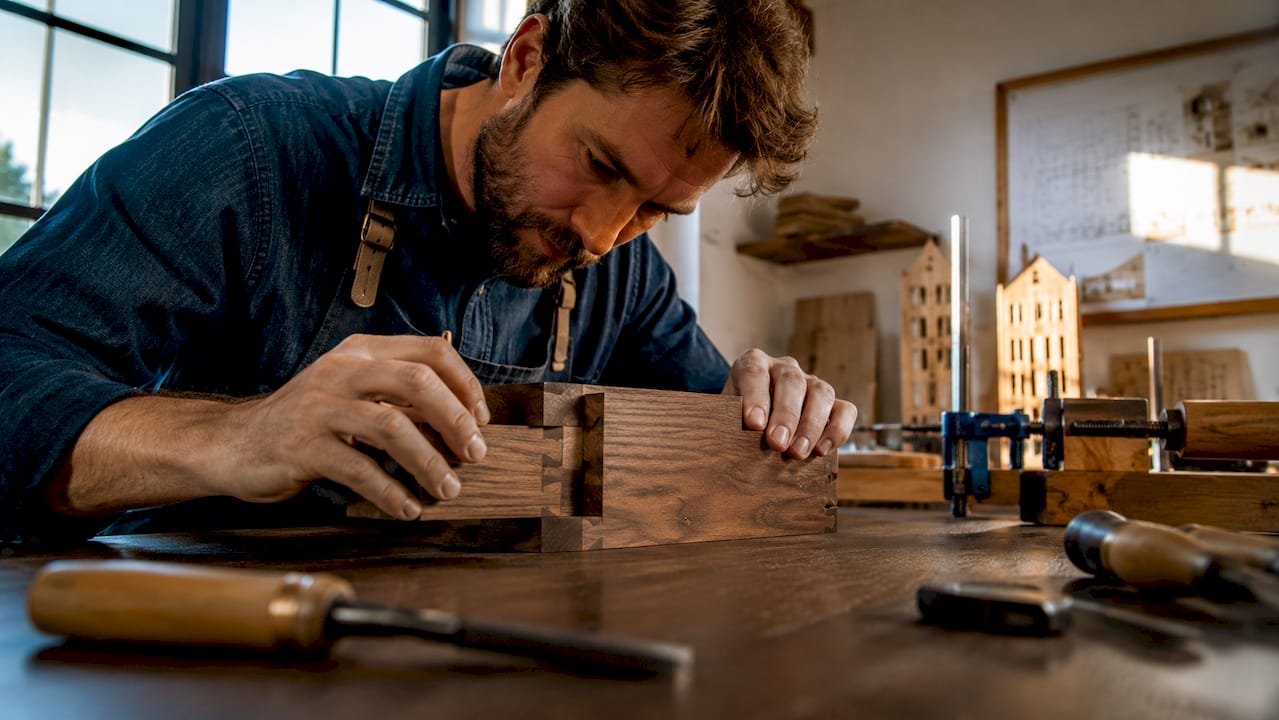
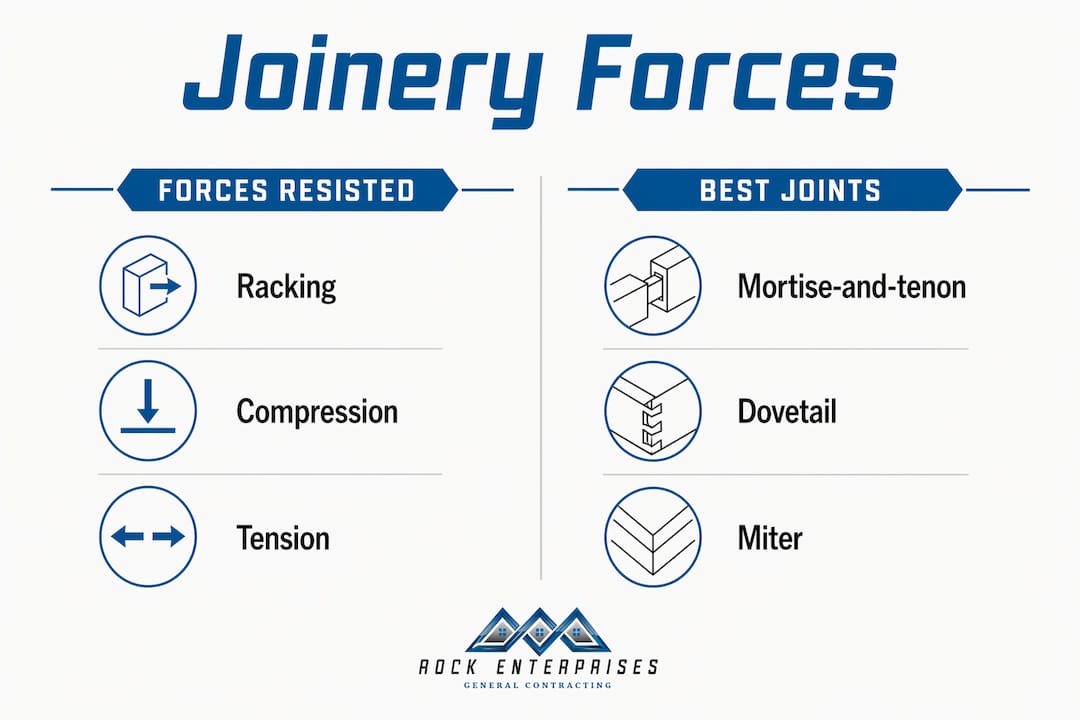
Every joint in a wood structure must resist specific forces. Mechanical strength depends on resisting tension, compression, shear, and racking forces, and each joint type is engineered for a specific set of those forces. Choosing the wrong joint for the load is one of the most common reasons DIY projects fail prematurely.
How each force type maps to a joint
Racking is the twisting or parallelogram-style distortion that happens when a frame is pushed sideways. The mortise-and-tenon joint is the standard answer to racking because its long glue surfaces and mechanical interlock resist lateral movement. Mortise-and-tenon joints achieve glue bond strengths exceeding 3,000 psi with precise craftsmanship, making them the benchmark for chairs, tables, and door frames.
Tension forces try to pull two pieces apart. Dovetail joints are the best answer here. Dovetail joints resist pull-out forces ten times more effectively than butt joints, with butt joints reaching only around 200 psi unglued versus over 4,000 psi for a properly glued dovetail. That gap explains why every quality drawer box uses dovetails at its corners.
Miter joints sit at the other end of the spectrum. They look clean and are common in trim and picture frames, but glue on end-grain surfaces provides only one-tenth the bond strength of long-grain to long-grain contact. A miter joint is a visual choice, not a structural one. When load is expected, it needs reinforcement with splines, biscuits, or fasteners.
| Joint type | Forces resisted | Best use |
|---|---|---|
| Mortise-and-tenon | Racking, compression | Chair legs, door frames, tables |
| Dovetail | Tension, pull-out | Drawer corners, box construction |
| Miter | Minimal structural load | Trim, picture frames, decorative edges |
| Biscuit | Alignment, light shear | Panel glue-ups, cabinet face frames |
| Pocket hole | Shear, light tension | Cabinet assembly, quick DIY builds |
Pro Tip: Before choosing a joint, ask yourself what force the connection will face in use. A bookshelf side panel faces downward compression and some racking. A drawer corner faces constant tension. Match the joint to the force, not to what looks impressive.
How does wood movement affect joinery choices?
Wood is hygroscopic. It absorbs and releases moisture from the air, and that movement is not optional. Wood expands across the grain by 5–10% with humidity changes and less than 0.3% along the grain. That difference is enormous, and joinery that ignores it will fail.
The problem shows up most clearly in wide panels. A solid wood tabletop that is glued rigidly to a cross-grain base will crack as the seasons change. The wood wants to move, and if the joint will not let it, the wood breaks instead. Gaps appear in summer when wood shrinks, and splits appear in winter when it swells against a rigid constraint.
Skilled joinery accommodates movement rather than fighting it. Several techniques exist specifically for this purpose:
- Floating panels: A raised panel sits in a groove without glue, free to expand and contract. Frame-and-panel cabinet doors use this method. The frame stays stable while the panel moves inside it.
- Drawbored mortise-and-tenon: A peg is driven through a slightly offset hole, pulling the joint tight mechanically. Mechanical interlocks like drawbored joints remain structurally sound even if glue degrades over decades, because the geometry of the joint carries the load.
- Slotted screw holes: When attaching a solid wood top to a cabinet base, slotted holes in the mounting clips let the top slide slightly as it moves. The connection stays firm without cracking the wood.
- Breadboard ends: A breadboard end is attached with a single center peg and elongated holes at the outer pegs, letting the main panel move while the end grain stays flat.
Choosing the right renovation materials matters as much as the joint itself. Engineered wood products like plywood and MDF move far less than solid wood, which changes which joinery methods make sense for a given project.
Joinery that forces rigid cross-grain connections leads to cracking, so techniques that allow natural expansion and contraction are not optional refinements. They are requirements for any project meant to last.
Which joinery method should you choose for your project?
Selecting the right joint comes down to four factors: the load the joint will carry, the skill level required to cut it, how visible the joint will be, and whether you need the connection to be permanent or adjustable.
Here is a practical selection process for typical home renovation projects:
- Define the load. Will the joint face racking, tension, or mostly compression? A cabinet carcass faces racking and compression. A drawer box faces tension. A decorative trim joint faces almost no structural load.
- Assess your tools and skill. Dovetail joints require a sharp chisel, a dovetail saw, and practice. Pocket hole joints require a jig and a drill. If you are new to woodworking, pocket holes and biscuit joints give you a solid result without a steep learning curve.
- Consider visibility. A dovetail on a drawer front is a visual statement of quality. A pocket hole on the same drawer front looks unfinished. Use mechanical interlocks where the joint will be seen, and faster methods where it will be hidden.
- Decide on permanence. Mortise-and-tenon and dovetail joints are essentially permanent once glued. Pocket hole joints can be disassembled. For built-ins and furniture meant to last, permanent mechanical joints are the right call.
Mechanical interlocks carry structural loads independently of glue, which is why joint geometry matters more than adhesive strength alone. Glue fails over time in humid environments. A well-cut mortise-and-tenon does not.
Pro Tip: When planning a custom carpentry project, sketch the joint location and draw an arrow showing the direction of the primary force. That single step will tell you which joint to use before you ever pick up a saw. You can find more guidance on planning your carpentry project before you start cutting.
Understanding the difference between finish and rough carpentry also helps you calibrate how much joinery precision each part of your project actually needs.
What mistakes do DIYers commonly make with joinery?
The most expensive joinery mistake is rushing. A joint cut too fast produces a gap, and a gap changes everything. Precision in joinery means tolerances within 0.005 inches. Gaps larger than that compromise the glue bond and reduce joint strength significantly. A snug, piston-fit joint is the professional standard for a reason.
The second most common mistake is relying on end-grain glue surfaces. Many beginners glue a butt joint at the end of a board and expect it to hold under load. End grain absorbs glue rather than bonding with it, which is why end-grain joints fail under stress. Long-grain to long-grain contact is the foundation of a strong glue bond.
Other frequent errors include:
- Ignoring wood movement. Gluing a wide panel rigidly across the grain and then wondering why it cracked six months later. Always plan for seasonal movement before you cut.
- Mismatching joint to function. Using a miter joint on a load-bearing shelf bracket because it looks clean. The joint will open under load within months.
- Skipping test fits. Glue-up is not the time to discover the joint is too tight or too loose. Dry-fit every joint before applying adhesive.
Rushing joinery leads to tear-out, gaps, and glue-line separation, causing failures as wood shifts over time. Patience and test-fitting are not optional steps. They are the work.
Pro Tip: Cut a test joint in scrap wood before committing to your project piece. If the test joint fits well and the glue bond feels solid after 24 hours, you are ready. If it does not, adjust your technique on scrap, not on the wood you paid for.
A well-planned kitchen renovation workflow depends on this kind of precision at every stage, especially where cabinet boxes and face frames meet.
Key Takeaways
Strong joinery technique is the single most reliable predictor of whether a wood renovation project holds up for decades or fails within a few years.
| Point | Details |
|---|---|
| Match joint to force | Mortise-and-tenon resists racking; dovetails resist tension; miters carry minimal load. |
| Plan for wood movement | Wood expands 5–10% across the grain; use floating panels or drawbored joints to prevent cracking. |
| Precision is non-negotiable | Tolerances within 0.005 inches maintain glue bond integrity and joint strength. |
| Mechanical interlocks outlast glue | Joints with geometric interlocks stay sound even if adhesive degrades over decades. |
| Test before you commit | Dry-fit every joint and cut practice joints in scrap before working on your final piece. |
What I have learned from years of watching joinery succeed and fail
The concept that changed how I think about joinery is what master craftsmen call “honesty.” Simple, well-fitted joints suited to a project’s mechanical needs outperform flashy but unsuitable designs every time. I have seen beautifully cut dovetails used in the wrong application fail faster than a basic pocket hole joint used correctly.
The other thing experience teaches you is that wood is not passive. It moves, it responds to its environment, and it will expose every shortcut you took. Craftsmen who treat joinery as a dialogue with the material, rather than a mechanical assembly task, produce work that lasts. Patience is not a soft skill in carpentry. It is the technical requirement that separates work that holds from work that does not.
If you take one thing from this, let it be this: choose the simplest joint that honestly meets the mechanical and visual demands of your project. A tight, well-cut biscuit joint beats a sloppy dovetail every time.
— ryan
How Rockenterprisecontracting delivers renovation results that hold up
Joinery knowledge matters most when it is applied by someone who has done it hundreds of times. Rockenterprisecontracting is a licensed, family-owned general contracting company based in Shrewsbury, NJ, with a 5.0-star rating on Thumbtack and a 100% positive feedback score. The owner personally oversees every project, which means the craftsmanship decisions, including joinery, are made by someone with real accountability.

Whether you are planning a kitchen remodel, a bathroom renovation, or custom built-ins, the team brings the same attention to fit and finish that separates lasting work from work that needs redoing. Explore the full range of personalized renovation services available for homeowners across Monmouth and Ocean County, or learn how a well-executed renovation increases home comfort in ways that go well beyond aesthetics.
FAQ
What is the strongest wood joint for furniture?
The mortise-and-tenon joint is the strongest choice for furniture frames, achieving glue bond strengths exceeding 3,000 psi with precise craftsmanship. It resists racking forces better than any other common joint.
Why do dovetail joints cost more to produce?
Dovetail joints require precise hand or machine cutting with tight tolerances, which takes significantly more time than simpler joints. Their pull-out resistance of over 4,000 psi when glued makes them worth the added effort for drawer boxes and case construction.
Can I use glue alone without a mechanical joint?
Glue on long-grain surfaces is strong, but glue alone on end grain provides only one-tenth the bond strength of a long-grain connection. Mechanical interlocks like mortise-and-tenon or dovetail joints remain structurally sound even if the glue degrades over time.
How does wood movement cause joinery failures?
Wood expands 5–10% across the grain with seasonal humidity changes. Joints that force rigid cross-grain connections prevent that movement, causing the wood to crack or the joint to open. Floating panels, slotted screw holes, and drawbored joints allow the wood to move without stressing the connection.
What joinery method works best for beginner DIYers?
Pocket hole joinery is the most accessible starting point for beginners. It requires only a jig and a drill, produces reliable shear resistance for cabinet assembly, and allows for disassembly if needed. As skills develop, biscuit joints and then mortise-and-tenon joints are natural next steps.