
TL;DR:
- Verifying a contractor’s credentials and obtaining three detailed, comparable estimates are essential to prevent scams.
- Homeowners should follow safe payment practices, including limiting upfront deposits and tying payments to documented project milestones.
Contractor fraud is defined as a deliberate scheme where a hired contractor takes payment without completing agreed work, performs substandard work, or disappears entirely. Contractor fraud costs American homeowners about $3 billion annually. That figure means the average homeowner faces real financial risk every time they hire someone for a renovation project. To avoid renovation contractor scams, you need to verify credentials before signing anything, compare at least three written estimates, and structure payments around project milestones. Monmouth County homeowners who follow these steps consistently protect their investment and avoid the most common traps.
How to avoid renovation contractor scams by verifying credentials
Verifying a contractor’s credentials is the single most effective step you can take before any money changes hands. Fake license numbers are a common scam. Verification requires checking the New Jersey Division of Consumer Affairs contractor database to confirm the license is current, valid, and matches the contractor’s name and business.
Here is what to check during the verification process:
- State license status. Look up the contractor’s license number in the official New Jersey state database. Confirm the name on the license matches the name on the estimate and any contract.
- Physical business address. Legitimate contractors always have a physical business address. A P.O. Box only means you have no way to hold them accountable if something goes wrong.
- Complaint history. Search the Better Business Bureau and the New Jersey Division of Consumer Affairs for unresolved complaints. Repeated client complaints on public databases are a critical warning sign.
- Insurance certificates. Ask for proof of general liability insurance and workers’ compensation. Call the insurer directly to confirm the policy is active.
- Professional references. Request at least three references from recent local projects. Call them and ask specific questions about timeline, communication, and whether the final cost matched the estimate.
Pro Tip: When you call a reference, ask one question that reveals the most: “Would you hire this contractor again without hesitation?” A pause before “yes” tells you more than the answer itself.
For a detailed walkthrough of the full process, the guide on verifying contractor credentials in New Jersey covers each step in order.

Why do multiple written estimates matter so much?
Getting multiple estimates is not just about finding the lowest price. It is about calibrating what a fair price actually looks like for your specific project. Homeowners should get at least three written estimates based on identical project specifications. Without that baseline, you have no way to know whether a bid is fair, inflated, or suspiciously low.
Follow these steps when collecting and comparing estimates:
- Write a detailed project scope first. List every material, finish, and task you want completed. Send the exact same document to every contractor so you are comparing identical work.
- Request fully itemized estimates. Each estimate should break down labor costs, material costs, timeline, and any work explicitly excluded from the bid.
- Flag bids that are far below the others. Bids 30% or more below the average often signal bait-and-switch tactics or the use of inferior materials. A low bid is not a bargain if the contractor plans to cut corners on safety or durability.
- Evaluate transparency, not just price. A contractor who explains every line item is demonstrating professionalism. One who gives you a single lump sum and resists questions is not.
- Check the timeline. An unusually short timeline can mean the contractor is overcommitted or planning to rush the work.
| Estimate element | What to look for |
|---|---|
| Labor costs | Broken out separately from materials |
| Material specifications | Brand names or grades listed, not just “tile” or “lumber” |
| Project timeline | Start date, milestones, and completion date |
| Exclusions | Work not covered clearly stated |
| Payment schedule | Tied to milestones, not arbitrary dates |
Pro Tip: Ask each contractor to walk you through their estimate line by line. A legitimate professional welcomes that conversation. A scammer avoids it.
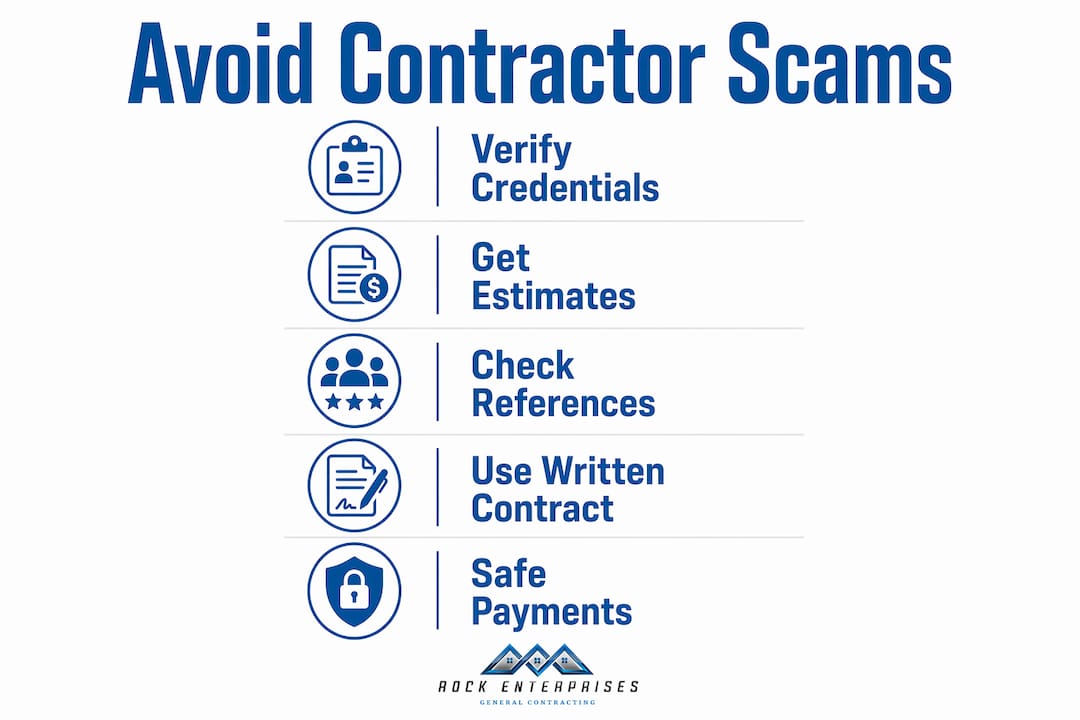
The guide on comparing contractor quotes the right way gives you a practical framework for evaluating bids side by side.
What are the safest payment practices for home renovation?
Payment structure is where most contractor scams succeed or fail. The industry standard upfront deposit is 10–15%, with remaining payments tied to verified project milestones. That structure protects you because the contractor only gets paid when they deliver measurable progress.
Safe payment practices every Monmouth County homeowner should follow:
- Never pay more than 30% upfront. Anything beyond that gives a dishonest contractor enough money to walk away and still profit.
- Avoid cash-only payment demands. Cash leaves no paper trail. Pay by check or credit card so you have documentation of every transaction.
- Tie every payment to a milestone. Define the milestones in writing before work begins. Examples include framing completion, rough electrical inspection passed, and tile installation finished.
- Demand lien waivers before final payment. Without lien waivers, you remain legally responsible for unpaid subcontractors, even after you have paid the general contractor in full. A lien on your property can follow you through a sale.
- Withhold final payment until you approve the work. Walk through the completed project with a checklist before releasing the last payment.
- Reject pressure to pay early. A contractor who demands payment ahead of schedule or invents reasons to accelerate the payment timeline is a red flag.
“The moment a contractor asks for full payment before the job is done, or insists on cash with no receipt, you are no longer dealing with a professional. You are dealing with someone who has already planned for the possibility of not finishing the work.”
What are the warning signs of a scam contractor?
Scam contractors rely on predictable psychological tactics. Recognizing those tactics early is the fastest way to protect yourself. High-pressure sales tactics like urgency claims and pressure to sign immediately are among the most common warning signs of renovation fraud.
Watch for these red flags:
- Unsolicited door-to-door offers. A contractor who shows up uninvited claiming they “noticed a problem” with your roof or siding is using a classic setup for an inflated or fraudulent job.
- Urgent deadlines that only apply to you. Claims like “this price is only good today” or “I have another job starting tomorrow” are designed to stop you from doing research.
- Claims of leftover materials. “I have extra materials from a nearby job” is a setup for substandard work using mismatched or inferior supplies.
- Refusal to pull permits. Legitimate contractors pull permits because permits create accountability. A contractor who suggests skipping permits is either unqualified or planning work that would not pass inspection.
- Disappearing during the project. Inconsistent communication, missed check-ins, and unexplained absences during active work are signs of a contractor who is overextended or disengaged.
- Requests for additional money mid-project without written change orders. Scope creep is normal. Demanding cash for undocumented changes is not.
For additional consumer protection guidance specific to New Jersey residents, the NYS Division of Consumer Protection publishes updated alerts on contractor fraud tactics.
What should a solid renovation contract include?
A written contract is your primary legal protection. Without one, you have almost no recourse if a contractor abandons the project or delivers substandard work. Every renovation contract should include these elements:
- Detailed scope of work. List every task, material specification, and finish. Vague language like “install flooring” is not enough. Specify the brand, grade, and color.
- Payment schedule tied to milestones. The contract must state exactly what triggers each payment and include a clause withholding the final payment until you formally approve the completed work.
- Written change order requirement. Any change to the scope, timeline, or cost must be approved in writing by both parties before work on that change begins.
- Contractor’s license and insurance information. The contract should reference the license number and insurance policy so both are on record.
- Subcontractor disclosure. Know who will be working in your home. The contract should name any subcontractors and confirm they are also licensed and insured.
- Warranty terms. Specify what the contractor warrants, for how long, and what the process is for addressing defects after completion.
- Lien waiver clause. Require the contractor to provide signed lien waivers from all subcontractors and suppliers before you release final payment.
Pro Tip: Before signing, have a real estate attorney or a trusted advisor review the contract. A one-hour consultation costs far less than a dispute over an ambiguous clause.
The renovation contracts checklist for homeowners covers every clause you need in plain language.
Key Takeaways
Avoiding contractor fraud requires verified credentials, structured payments, and a detailed written contract before any work begins.
| Point | Details |
|---|---|
| Verify credentials first | Check license status in the New Jersey state database and confirm a physical business address. |
| Get three written estimates | Compare bids based on identical project specs and flag any bid 30% or more below the average. |
| Cap upfront deposits at 30% | The industry standard is 10–15% upfront; tie all remaining payments to verified milestones. |
| Demand lien waivers | Collect signed lien waivers from all subcontractors before releasing final payment. |
| Use a detailed written contract | Include scope, payment schedule, change order process, and warranty terms in every contract. |
What I have learned from watching homeowners get burned
The pattern I see most often is not greed. It is impatience. A homeowner gets excited about a project, finds a contractor who seems friendly and quotes a reasonable price, and signs before doing any real research. Two weeks later, the contractor has disappeared with a large deposit and the homeowner has no license number to trace, no physical address to visit, and no contract specific enough to enforce.
The uncomfortable truth is that most contractor fraud is preventable. It does not require sophisticated deception. It requires a homeowner who is in a hurry. The scammers know this. They create urgency, offer discounts for quick decisions, and make the paperwork feel like an obstacle rather than a protection.
What actually works is slowing down. Spend a week researching before you spend a dollar. Call three references. Look up the license. Read every line of the contract. If a contractor pushes back on any of that, you have your answer before you have lost anything.
Local consumer protection resources in New Jersey are underused. The Division of Consumer Affairs maintains a public complaint database that takes five minutes to search. That five minutes has saved homeowners thousands of dollars. Use it every time, without exception.
— ryan
Trusted local renovation starts with the right contractor
Choosing a licensed, insured contractor with a verifiable track record is the most direct way to protect your renovation investment in Monmouth County.

Rockenterprisecontracting is a licensed, family-owned general contracting company based in Shrewsbury, NJ, with a 5.0-star rating on Thumbtack and a 100% positive feedback score. The owner personally oversees every project, which means transparent pricing, milestone-based payments, and lien waiver protocols are standard practice, not optional extras. Whether you are planning a kitchen remodel or a full bathroom renovation, Rockenterprisecontracting delivers verified craftsmanship with the documentation to back it up. You can also explore personalized renovation services to find the right fit for your project and budget.
FAQ
What is the safest upfront deposit for a renovation contractor?
The industry standard upfront deposit is 10–15% of the total project cost. Never pay more than 30% before work begins, and always tie remaining payments to verified milestones.
How do I check if a contractor’s license is real?
Search the New Jersey Division of Consumer Affairs contractor database using the license number the contractor provides. Confirm the name, business address, and license status match exactly what the contractor gave you.
What are the biggest red flags when hiring a contractor?
The clearest red flags include demands for large cash payments upfront, refusal to pull permits, high-pressure urgency tactics, no physical business address, and unwillingness to provide a detailed written contract.
Why do I need a lien waiver from my contractor?
Without a signed lien waiver, you can be held legally responsible for unpaid subcontractors even after you have paid the general contractor in full. A mechanic’s lien can attach to your property and complicate any future sale.
How many estimates should I get before hiring a contractor?
Get at least three written estimates based on the exact same project specifications. That comparison gives you a realistic price baseline and makes suspiciously low or inflated bids immediately visible. You can learn more about evaluating contractor bids from a remodeling perspective to sharpen your judgment further.