
TL;DR:
- Whole-home renovation involves comprehensive updates to a house’s structure, systems, and finishes in a coordinated project. Proper planning, permits, trade sequencing, and contingency budgeting are essential for success, while delays often stem from skipped steps or late decisions. Choosing a licensed general contractor who manages the project ensures timely completion and minimizes costly rework.
A whole-home renovation is a coordinated remodeling effort that updates most or all of a house’s systems, structure, and finishes in a single project. Unlike swapping out a kitchen backsplash or repainting a bedroom, this type of work touches structural elements, mechanical systems, and every interior finish simultaneously. The industry term for the most intensive version is a “gut-to-studs remodel,” where walls are stripped to bare framing before rebuilding begins. Understanding what does whole-home renovation involve, from permits to punch lists, is the difference between a project that finishes on time and one that bleeds money for months.
What does whole-home renovation involve, step by step?
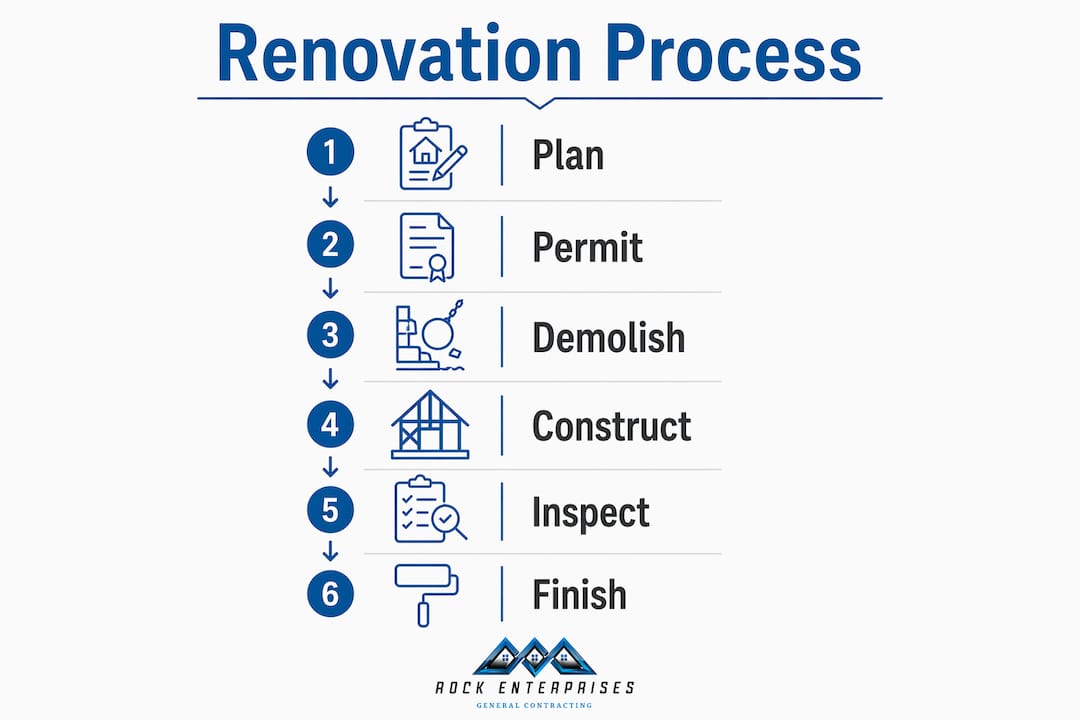
A sequenced renovation process starts with planning and design, moves through permits and demolition, and ends with finish work and a final walkthrough. Each phase feeds directly into the next, so skipping or rushing any step creates problems downstream. Here is the full sequence:
- Planning and design. You define the scope, hire an architect or designer if needed, and lock in a budget. Structural changes require engineered drawings before any permit application.
- Permit application and approvals. Building, electrical, plumbing, and mechanical permits are submitted to your local Authority Having Jurisdiction (AHJ). Approval timelines vary by municipality, from two weeks to two months.
- Demolition and structural work. Walls, flooring, and ceilings come down. Load-bearing modifications, foundation repairs, and framing changes happen here. Rockenterprisecontracting handles demolition services as a distinct phase to control debris and protect adjacent finishes.
- Rough-in for mechanical, electrical, and plumbing (MEP). Pipes, wires, and ductwork are run through open walls and ceilings. This phase ends with a rough-in inspection before anything gets covered.
- Insulation and drywall. Once rough inspections pass, walls close. Insulation goes in first, then drywall hanging, taping, and finishing.
- Finish work. Flooring, paint, cabinetry, tile, fixtures, and trim are installed in a specific order to avoid damage to completed surfaces.
- Final walkthrough and punch list. The contractor and homeowner walk the project together. Outstanding items are documented and corrected before final payment.
Pro Tip: Lock in your tile, fixture, and cabinet selections before demolition begins. Decision timing is one of the most overlooked causes of project stalls. Backordered materials discovered mid-project can delay flooring and trim by weeks.
How much does a whole-home renovation cost?

Cost depends almost entirely on scope tier. A cosmetic update covering paint, flooring, and fixtures runs far less than a gut-to-studs remodel that replaces every system in the house. Nearly a third of homeowners spend above $50,000 on whole-home renovations, with 17% exceeding $100,000. Those numbers reflect real market conditions in 2026, not outliers.
The table below breaks down typical cost ranges and the contingency reserve you should hold at each scope level.
| Scope tier | Typical cost range | Recommended contingency |
|---|---|---|
| Cosmetic (paint, flooring, fixtures) | $20,000 to $50,000 | 5 to 8% |
| Full replacement (kitchens, baths, systems) | $50,000 to $150,000 | 8 to 12% |
| Gut-to-studs (full structural and system overhaul) | $150,000 and above | 12 to 20% |
A contingency fund is not a buffer for poor estimating. It exists specifically to cover unknowns discovered during demolition, such as rotted framing, outdated wiring, or plumbing that does not meet current code. Gut-to-studs projects carry the highest contingency requirement because the unknowns are greatest before walls open.
Beyond construction costs, a complete renovation bid should include permit fees, design and engineering fees, temporary housing if needed, and material storage. Accurate cost estimating reduces margin erosion and prevents the budget shock that derails projects in the final stretch.
Pro Tip: Get three itemized bids, not three lump-sum numbers. An itemized bid shows you exactly where money is going and makes scope comparisons between contractors meaningful.
What permits and inspections are required?
Permits and inspections are mandatory checkpoints that protect you legally and structurally. A project completed without permits can trigger fines, forced demolition of completed work, and complications when you sell the home. Permits typically required for a whole-home renovation include:
- Building permit. Covers structural changes, additions, and general construction scope.
- Electrical permit. Required any time wiring is added, moved, or upgraded beyond a simple fixture swap.
- Plumbing permit. Covers new drain lines, supply lines, and fixture relocations.
- Mechanical permit. Required for HVAC system changes, ductwork modifications, and new equipment installation.
Inspections occur at specific hold points in the schedule. Rough-in inspections for electrical, plumbing, and HVAC must pass before walls close. Rough-in inspections act as hard gates in the schedule, meaning no drywall goes up until the inspector signs off. Rushing past this point and closing walls before approval is one of the most expensive mistakes a homeowner can make. Rework after failed inspections means cutting open finished walls, correcting the work, and re-inspecting.
Final inspections happen at project completion and are required before the home receives occupancy approval. A licensed contractor manages the permit application process, schedules inspections, and coordinates trade sequencing around inspection hold points. This is one of the clearest reasons to hire a licensed general contractor rather than managing trades independently.
What challenges should you expect during a whole-home renovation?
Coordinating multiple trades is the most underestimated complexity in a whole-home project. Electricians, plumbers, HVAC technicians, framers, tile setters, and finish carpenters all need to work in a specific order, and each trade’s schedule depends on the one before it. Common challenges include:
- Material and fixture lead times. Custom cabinetry can take 8 to 12 weeks. Specialty tile and plumbing fixtures from manufacturers like Kohler or Waterworks can run longer. Ordering late pushes every downstream trade.
- Unexpected conditions behind walls. Older homes in Monmouth and Ocean County frequently reveal knob-and-tube wiring, galvanized pipes, or asbestos-containing materials once demolition begins. Gut-to-studs projects require hazardous material testing before work proceeds, adding both time and cost.
- Scope changes mid-project. Changing your mind about a wall location or cabinet layout after rough-in has started is expensive. Every change order affects labor, materials, and the inspection schedule.
- Subcontractor scheduling conflicts. A plumber delayed by another job pushes your HVAC rough-in, which pushes your insulation, which pushes your drywall. The cascade effect is real.
“The homeowners who navigate whole-home renovations most successfully are the ones who make decisions early and hold to them. Indecision mid-project is the single biggest driver of cost overruns and schedule slippage.”
Effective project management in construction means anticipating these conflicts before they happen, not reacting after the schedule has already slipped. A general contractor with a structured project management process tracks material lead times, pre-schedules inspections, and communicates trade sequencing to every subcontractor on the job.
What are the benefits of a whole-home renovation vs. incremental updates?
A whole-home renovation delivers advantages that room-by-room updates simply cannot replicate. Addressing multiple systems together decreases the likelihood of piecemeal fixes and improves both livability and resale value. The comparison below makes the difference concrete.
| Factor | Incremental updates | Whole-home renovation |
|---|---|---|
| Design cohesion | Mismatched styles across rooms | Unified aesthetic throughout |
| System efficiency | Older systems remain in place | HVAC, electrical, plumbing all updated |
| Disruption | Repeated construction phases over years | Single concentrated disruption period |
| Cost efficiency | Higher total cost over time | Lower cost per system when bundled |
| Resale value | Partial improvements, partial returns | Comprehensive upgrades command stronger pricing |
The scope of a whole-home renovation commonly covers foundation, load-bearing walls, HVAC, electrical, plumbing, exterior cladding, insulation, flooring, cabinetry, and interior finishes. Tackling all of these in one project means trades are already mobilized, permits are already open, and design decisions are already made. Spreading the same work across five years means paying mobilization costs five times and living through construction five separate times.
Key takeaways
A whole-home renovation succeeds when planning, permitting, trade sequencing, and contingency budgeting are treated as equally critical phases, not afterthoughts.
| Point | Details |
|---|---|
| Sequencing is non-negotiable | Rough-in inspections must pass before walls close; skipping this causes costly rework. |
| Budget for unknowns | Hold a 12 to 20% contingency for gut-to-studs projects to cover conditions found during demolition. |
| Permits protect your investment | Unpermitted work creates legal and financial risk at resale and can require forced demolition. |
| Decide early, avoid delays | Locking in tile, fixtures, and cabinets before demolition prevents downstream trade stalls. |
| Whole-home beats piecemeal | Bundling systems and finishes into one project reduces total cost and disruption over time. |
What I’ve learned from managing whole-home renovations
After years of overseeing projects across Monmouth and Ocean County, the pattern I see most often is this: homeowners who struggle with whole-home renovations almost always skipped the planning phase. They had a vision, they had a budget number in their head, and they wanted to start swinging hammers. The planning phase feels like delay. It is not. It is the project.
The second thing I have learned is that contingency money is not optional. Every gut-to-studs project I have managed has found something unexpected behind the walls. Knob-and-tube wiring in a 1940s Cape Cod. Galvanized supply lines corroded to near-failure. A load-bearing wall that was not on any drawing. The contingency fund is what lets you handle those discoveries without a crisis conversation about money.
I also push hard on early finish selections. Homeowners want to focus on the big structural decisions first and “figure out tile later.” But tile, cabinetry, and fixtures drive the schedule for every trade that follows. A delayed cabinet order holds up countertop templating, which holds up plumbing fixture installation, which holds up the final inspection. The domino effect is predictable and entirely preventable.
My honest advice: hire a licensed general contractor who personally oversees the work, not one who delegates everything to a site supervisor you have never met. The renovation projects in our portfolio reflect what happens when an owner is on-site and accountable. That level of attention is not a luxury on a whole-home renovation. It is a requirement.
— ryan
Ready to plan your whole-home renovation with Rock Enterprises?
Rockenterprisecontracting is a licensed, family-owned general contracting company based in Shrewsbury, NJ, with a 5.0-star rating on Thumbtack and a 100% positive feedback score. The owner personally oversees every project, from the first permit application through the final punch list.

If you are planning a whole-home renovation in Monmouth or Ocean County, Rockenterprisecontracting brings the trade coordination, permit management, and craftsmanship your project requires. Explore the home renovation services and expert renovation work to see how the team approaches projects of every scope and scale. Contact Rockenterprisecontracting to request a detailed, itemized estimate and start your project on the right foundation.
FAQ
What does a whole-home renovation include?
A whole-home renovation covers structural work, mechanical systems (electrical, plumbing, HVAC), insulation, drywall, and all interior finishes including flooring, cabinetry, and fixtures. Projects must impact at least three major system categories to qualify as a whole-home renovation rather than a targeted remodel.
How long does a whole-home renovation take?
Most whole-home renovations take four to twelve months depending on scope, permit approval timelines, and material lead times. Gut-to-studs projects on larger homes routinely run six months or longer due to inspection hold points and trade sequencing requirements.
What is a realistic budget for a whole-home renovation?
Budgets vary by scope tier, but nearly a third of homeowners spend above $50,000 and 17% exceed $100,000. Add a contingency reserve of 12 to 20% for gut-to-studs projects to cover unknowns discovered during demolition.
Do you need permits for a whole-home renovation?
Yes. Building, electrical, plumbing, and mechanical permits are required for any work that alters structure or systems. Unpermitted work creates legal liability and can require demolition of completed work when discovered during a home sale.
What is the biggest risk in a whole-home renovation?
The biggest risk is inadequate planning before construction starts. Delayed finish selections, missing permits, and insufficient contingency funds are the three most common causes of budget overruns and schedule failures on whole-home projects.
Recommended
- Blog – Rock Enterprises | General Contractor Shrewsbury NJ
- Transform Your Living Space: The Ultimate Guide to Home Renovations with Rock Enterprises – Rock Enterprises | General Contractor Shrewsbury NJ
- Transform Your Living Space with Expert Home Renovations – Rock Enterprises | General Contractor Shrewsbury NJ
- 10 Types of Bathroom Renovation Styles for 2026