
TL;DR:
- A renovation contract is a legally binding agreement that defines the scope, payment terms, and responsibilities for a home improvement project. It protects homeowners from disputes, cost overruns, and misunderstandings by providing clear contractual obligations. Reviewing detailed scope, payment schedules, and warranties before signing ensures legal and financial safeguards throughout the renovation process.
A renovation contract is a legally binding agreement between a homeowner and a contractor that defines the scope of work, payment terms, project timeline, materials, and responsibilities for a home improvement project. Without one, you have no legal ground to stand on if a dispute arises, costs spiral, or work falls short of what was promised. Major renovations range from $30,000 for a kitchen remodel to $300,000 or more for whole-house projects, which means the financial stakes are too high to rely on a handshake or a verbal agreement. Understanding what a renovation contract covers is the single most effective way to protect your investment before the first nail is driven.
What is a renovation contract and why does it matter?
A renovation contract, sometimes called a construction or remodeling agreement, is a legally binding instrument that defines scope, compensation, materials, schedule, and remediation. It is the primary document that governs the relationship between you, your general contractor, and any subcontractors brought onto the job. Think of it as the rulebook everyone agrees to follow before work begins.
The renovation contract definition goes beyond a simple price quote. A quote tells you what a contractor thinks the job will cost. A contract locks in the terms, creates legal enforceability, and gives both parties a clear reference point if anything goes sideways. Verbal agreements and informal quotes are not sufficient safeguards. They lack defined scope and payment terms, which leaves you exposed to financial and legal risk.
Contracts also protect contractors. When the scope is clear and agreed upon in writing, there is less room for misunderstanding about what was included in the price. That clarity benefits everyone on the project.
What should be included in a renovation contract?
The detailed scope of work is the most critical element in any renovation contract. It should name every task to be performed, every material to be used, and every finish to be installed. Vague language like “install new flooring” invites disputes. Specific language like “install 500 square feet of 5-inch white oak hardwood, sanded and finished with two coats of water-based polyurethane” leaves no room for interpretation.
Beyond scope, a well-written renovation contract must include the following components:
- Payment schedule. A standard payment structure includes an initial deposit of roughly 30%, a milestone payment at 50% project completion, and a final payment at 100% completion. Tying payments to verified milestones protects you from paying for work that has not been done.
- Project timeline. The contract should state a start date, key milestone dates, and a projected completion date. A well-structured timeline holds the contractor accountable and helps you manage your household around the disruption.
- Change order procedures. Any modification to the original scope must be documented in writing and signed by both parties before work proceeds. This single clause prevents the most common source of renovation billing disputes.
- Warranties. Standard contracts include warranty terms that assure work quality and compliance with local building codes. Know what is covered and for how long.
- Licensing and insurance. The contract should confirm the contractor holds a valid license and carries both general liability insurance and workers’ compensation coverage.
- Dispute resolution. Specify whether disputes go to mediation, arbitration, or litigation. Mediation is typically faster and less expensive.
- Permit responsibilities. State clearly who is responsible for pulling permits and scheduling inspections.
Pro Tip: Ask your contractor to attach material specifications, product model numbers, and finish samples directly to the contract as exhibits. This makes the scope airtight and eliminates “that’s not what I meant” conversations later.
What are the common types of renovation contracts?
The three primary types of construction contracts used in residential renovation are lump sum, time and materials, and cost-plus. Each allocates financial risk differently, and choosing the wrong type for your project can cost you significantly.
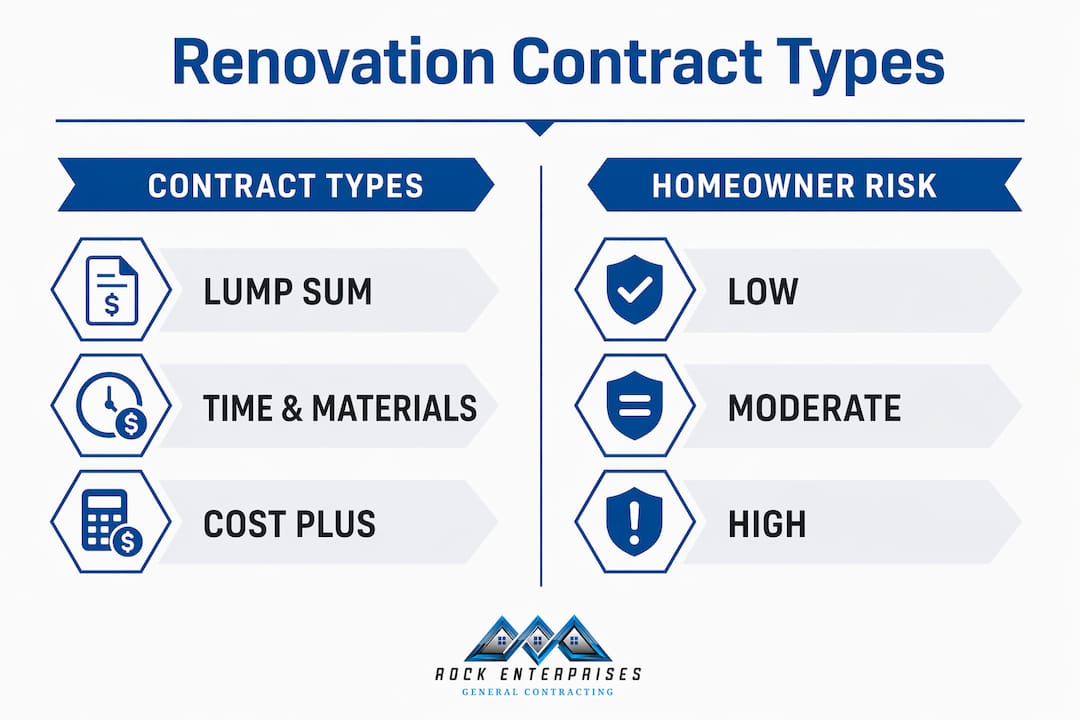
| Contract type | How it works | Best for | Homeowner risk |
|---|---|---|---|
| Lump sum (fixed price) | Contractor quotes one total price for a defined scope | Well-defined projects like a bathroom remodel | Low. Cost overruns fall on the contractor. |
| Time and materials (T&M) | Homeowner pays for actual labor hours and materials used | Projects with uncertain scope or phased work | Medium to high. Final cost is unpredictable. |
| Cost-plus | Homeowner pays all project costs plus a contractor fee (flat or percentage) | Complex or custom projects where scope evolves | High. No ceiling on total spend without a cap clause. |
Lump sum contracts transfer cost overrun risk to the contractor, which is why they require a clearly defined scope before signing. If the scope is fuzzy, the contractor will price in a contingency buffer, and you may overpay. Cost-plus contracts shift that financial risk back to you, but they offer more flexibility when the full scope cannot be determined upfront, such as a whole-house renovation where surprises inside the walls are likely.
For most homeowners tackling a single-room remodel, a lump sum contract with a detailed scope is the safest and most predictable option. For larger, more complex projects, a cost-plus contract with a guaranteed maximum price (GMP) clause gives you flexibility while capping your exposure.
How to write or review a renovation contract
Reviewing a renovation contract before signing is not optional. It is the most important hour you will spend on your renovation. Follow this checklist to verify every critical element is present before you put pen to paper.
- Confirm the scope is specific. Every task, material, brand, model, color, and finish should be named. If it is not in the contract, the contractor is not obligated to provide it.
- Check the payment schedule. Payments should be tied to completed milestones, not calendar dates. Never pay more than 10 to 15 percent upfront for smaller projects.
- Verify licensing and insurance. Ask for copies of the contractor’s license and insurance certificates. Call the insurer to confirm the policy is active.
- Read the change order clause. It must require written documentation and both signatures before any change is made. Oral approvals are not enforceable.
- Look for a timeline with consequences. A contract that includes a liquidated damages clause for undue delays gives you financial recourse if the project runs significantly over schedule.
- Confirm permit responsibility. The contract should name who pulls permits. In most jurisdictions, the licensed contractor is legally required to do this.
- Review the warranty terms. Understand what is covered, for how long, and what voids the warranty. Read the contractor warranty details carefully before signing.
Pro Tip: If the contract is for a project over $50,000, spend $300 to $500 having a construction attorney review it before you sign. That fee is trivial compared to the cost of a dispute.
A renovation contract checklist like the one above takes less than an hour to work through. That hour can save you thousands. Hidden costs in construction projects are common, and a thorough contract is your first line of defense against them.
Why a renovation contract is your best legal protection
Contracts protect all parties by establishing responsibilities, timelines, costs, warranties, and legal enforceability. Without a formal written contract, resolving a dispute can cost hundreds to thousands of dollars in mediation or legal fees. That expense is entirely avoidable.
Here is what a strong renovation contract prevents:
- Scope creep. Without a defined scope, contractors can add work and charge for it. With one, any addition requires a signed change order.
- Payment disputes. Milestone-based payment schedules prevent contractors from demanding large sums before work is complete.
- Abandoned projects. A contract with a timeline and payment structure gives you legal standing to withhold final payment if the contractor walks off the job.
- Warranty gaps. Without written warranty terms, you have no recourse if tile starts cracking six months after installation.
“The contract’s Detailed Scope of Work often acts as the homeowner’s primary defense against misunderstandings and additional costs.” — Renovation Contract Essentials
The financial stakes make this non-negotiable. A kitchen remodel averaging $30,000 or a home addition averaging $50,000 represents a significant portion of most homeowners’ net worth. A contract is not bureaucratic paperwork. It is the document that ensures you get what you paid for. For effective project management throughout the build, the contract is the foundation everything else is built on.
Key takeaways
A renovation contract is the single most important document in any home improvement project, and its scope of work clause is your strongest protection against cost overruns and disputes.
| Point | Details |
|---|---|
| Renovation contract definition | A legally binding agreement covering scope, payment, timeline, warranties, and dispute resolution. |
| Most critical element | The detailed scope of work prevents misunderstandings and limits costly change orders. |
| Contract type selection | Lump sum protects homeowners from overruns; cost-plus offers flexibility but transfers financial risk. |
| Payment schedule structure | Tie payments to verified milestones, not dates, with an initial deposit around 30%. |
| Legal protection value | Without a written contract, dispute resolution can cost thousands in avoidable legal fees. |
What I’ve learned from watching homeowners skip this step
I have seen the same mistake play out more times than I can count. A homeowner gets three quotes, picks the contractor they like best, and starts the project on a handshake because “he seemed trustworthy.” Six weeks later, the contractor is asking for more money because “that wasn’t in the price,” and the homeowner has no written document to push back with.
The most common misconception I encounter is that a detailed quote is the same as a contract. It is not. A quote is an estimate. A contract is a legal commitment. The difference between those two documents can be the difference between a smooth renovation and a lawsuit.
I also see homeowners treat the contract as a formality rather than a tool. They skim it, sign it, and file it away. The homeowners who get the best outcomes are the ones who read every line, ask questions about anything unclear, and push back on vague language before signing. A contractor who resists adding specifics to the scope is telling you something important about how they plan to run the job.
One more thing worth saying plainly: the size of the project does not determine whether you need a contract. I have seen $8,000 bathroom tile jobs turn into $15,000 nightmares because nothing was in writing. Get it in writing every single time.
— ryan
Work with a contractor who makes contracts easy

At Rockenterprisecontracting, every project starts with a clear, detailed written contract before a single tool is unpacked. Rock Enterprises is a licensed, family-owned general contracting company based in Shrewsbury, NJ, serving homeowners across Monmouth and Ocean County. The owner personally oversees every project, which means you always know who is accountable. Their 5.0-star rating on Thumbtack reflects a consistent track record of transparent pricing and quality craftsmanship. If you are planning a kitchen remodel, bathroom renovation, or any major home improvement, start with their complete renovation guide to understand exactly what a professional, contract-backed renovation looks like from start to finish.
FAQ
What is a renovation contract in simple terms?
A renovation contract is a written legal agreement between a homeowner and a contractor that specifies the work to be done, the cost, the timeline, and each party’s responsibilities. It is the document that makes verbal promises legally enforceable.
What should always be included in a renovation contract?
Every renovation contract should include a detailed scope of work, a milestone-based payment schedule, a project timeline, change order procedures, warranty terms, and proof of contractor licensing and insurance.
What is the difference between a quote and a renovation contract?
A quote is an informal cost estimate with no legal weight. A renovation contract is a signed legal document that binds both parties to specific terms, making it the only document that provides real protection for homeowners.
Which type of renovation contract is best for homeowners?
For projects with a clearly defined scope, a lump sum contract is generally best because it fixes the total price and places cost overrun risk on the contractor. For complex or evolving projects, a cost-plus contract with a guaranteed maximum price clause offers more flexibility while limiting financial exposure.
Can a renovation contract be changed after signing?
Yes, but only through a formal change order that is documented in writing and signed by both the homeowner and the contractor before any additional work begins. Oral agreements to modify a contract are not legally enforceable.
Recommended
- Blog – Rock Enterprises | General Contractor Shrewsbury NJ
- What Is a Contractor Warranty? a Homeowner’s Guide
- Transform Your Living Space: The Ultimate Guide to Home Renovations with Rock Enterprises – Rock Enterprises | General Contractor Shrewsbury NJ
- Deck Renovation Coastal New Jersey: What to Know