
A solid remodel budget is not a spreadsheet exercise. It is the single document that turns your family’s goals into a funded, sequenced plan with a real finish line. Renovation projects often exceed initial budgets by 20–30% on average, with hidden costs usually responsible for the overruns. The role of budget planning in a family remodel is to close that gap before demolition starts, not after the surprises arrive.
Three moves get you there fast:
- Define scope and finish level before you price anything. Walls moved, systems touched, cosmetic finishes chosen.
- Get a detailed, line-item estimate from at least two contractors. Not a $/sq ft ballpark.
- Lock a contingency of 10–20% and treat it as untouchable until a real surprise forces your hand, per common industry guidance: 10% for low-risk cosmetic work, up to 20% or more for older homes or structural projects.
Table of Contents
- Why budget planning prevents stress and overruns for families
- Start with scope and finish levels, not a price per square foot
- Common hidden costs families often overlook
- How to set a family remodel budget you can stick to
- Financing options families commonly use
- How to get and compare contractor bids the right way
- Contingency planning and controlling cost overruns
- A sample budget worksheet families can use
- How Rock Enterprises helps families plan and control remodel budgets
- Key Takeaways
- Why contractor-led budgeting works better for families
- Rockenterprisecontracting: scope-first budgeting for NJ families
- FAQ
Why budget planning prevents stress and overruns for families
Poor budgeting does not just drain a bank account. It stalls projects mid-construction, forces families into temporary housing longer than planned, and turns a kitchen into a plywood shell for months. Budget overruns are a predictable result of skipping scope definition and underestimating hidden costs.
Financial advisors also flag a guardrail worth knowing: avoid spending more than roughly 30% of your home’s current value on renovations. Exceed that threshold and you risk over-improving relative to neighborhood comparables, which limits resale recovery. On the upside, a midrange kitchen remodel recouped roughly 72% of its cost at resale, according to the 2026 Cost vs. Value Report.
Pro Tip: Set your contingency at the start and treat it as a locked reserve. Spending it on an upgrade you want is how families run out of money for the structural surprise they did not see coming.
Hidden costs that routinely blow budgets:
- Permit fees and inspection costs
- Asbestos or lead remediation in pre-1980 homes
- Electrical panel upgrades or plumbing brought to current code
- Structural repairs uncovered after demo
- Temporary housing or storage during construction
- Debris hauling and disposal
- Remobilization costs when delays push trades off schedule
Start with scope and finish levels, not a price per square foot
Industry professionals consistently advise that scope and finish-level decisions produce far more accurate budgets than any $/sq ft rule of thumb. That figure is a screening tool, not a budget.
How to document your scope:
- List every room affected and what changes in each.
- Identify structural vs. cosmetic work (walls moved, load-bearing changes, systems touched).
- Note what stays vs. what gets replaced (cabinets, fixtures, flooring, appliances).
- Flag trades involved: plumbing, electrical, HVAC, carpentry.
- Assign a finish level to each area: economy, mid-grade, or premium.
Finish levels move costs dramatically. Economy-grade tile, stock cabinets, and builder fixtures cost a fraction of custom cabinetry, stone countertops, and designer hardware. Choosing materials for your remodel before you price the job means your estimate reflects what you actually want, not a generic average.
Once scope is documented, sort every item into three columns: must-have now, phase 2, and future upgrade. This prioritization step is where most families recover budget without sacrificing the project’s core goals.

Common hidden costs families often overlook
Hidden costs are the most common source of overruns, and they share one trait: they only appear after demo starts. Planning for them in advance is the difference between a contingency that holds and one that evaporates in week two.
- Permits and inspections: Required for most structural, electrical, and plumbing work. Fees vary by municipality but are non-negotiable.
- Code compliance upgrades: Older homes frequently require electrical panels, plumbing, or HVAC brought to current code before new work can proceed.
- Structural repairs: Rot, termite damage, or undersized framing discovered behind walls adds both cost and schedule days.
- Asbestos/lead testing and remediation: Common in homes built before 1980. Remediation is licensed work and cannot be skipped.
- Temporary housing and storage: A full kitchen or bathroom gut often makes the space unusable for weeks.
- Debris hauling: Dumpster rental and disposal fees are real line items, not afterthoughts.
- Delay-driven remobilization: When one trade falls behind, others reschedule, and each reschedule can carry a mobilization fee.
Timeline impact is just as real as dollar impact. A two-week structural repair does not just cost money. It pushes every subsequent trade, extends your carrying costs, and increases the chance of a second round of delays.
How to set a family remodel budget you can stick to
Build your budget from a defined scope and line-item estimates, not a $/sq ft guess. Preconstruction estimates and quantity takeoffs are what allow you to compare bids on equal terms and catch gaps before they become change orders.
Step-by-step process:
- Finalize scope and finish levels for every room and trade.
- Create a quantity takeoff or detailed checklist of materials and labor by category.
- Get 2–3 itemized bids from licensed, insured contractors using the same scope document.
- Set contingency at 10–20%, calibrated to project risk: 10% for low-risk cosmetic work, 15% for mid-complexity projects, and 20% or more for older homes or structural projects.
- Choose financing and set a payment schedule tied to project milestones, not contractor requests.
- Sign a written contract that includes scope, allowances, change-order policy, and milestone payments.
Worksheet fields to capture:
- Estimated vs. actual cost per trade
- Material allowances (what happens if you go over)
- Permit and inspection fees
- Soft costs: design, engineering, expediting
- Contingency line (separate, not folded into trade budgets)
- Financing costs if applicable
Typical budget allocation ranges:
| Category | Approximate share of total budget |
|---|---|
| Structural / shell work | 30% |
| Systems (plumbing, electrical, HVAC) | 20–30% |
| Finishes (cabinets, tile, fixtures, paint) | 20% |
| Soft costs, permits, temporary housing | 5–10% |
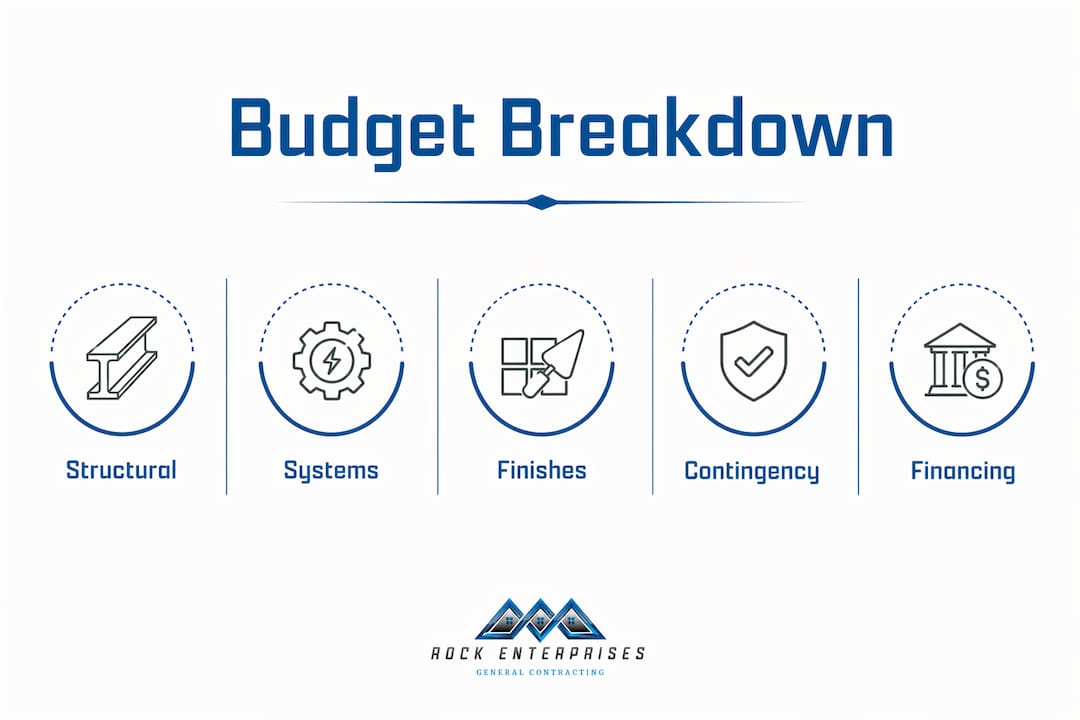
Finalizing design selections early is one of the highest-leverage moves a family can make. Late selections are the single biggest driver of change-order costs.
Financing options families commonly use
Choose financing that keeps monthly costs manageable and leaves room for contingency draws. Short-term, high-interest solutions are a poor match for structural work that takes months to complete.
| Option | Best for | Key trade-off |
|---|---|---|
| Cash / savings | Any size project | No interest cost; depletes liquidity |
| HELOC | Mid-to-large projects | Variable rate; flexible draws |
| Home equity loan | Large, defined-scope projects | Fixed rate; lump sum upfront |
| Cash-out refinance | Large projects with rate benefit | Resets mortgage; closing costs |
| Personal loan | Smaller cosmetic projects | Higher rate; no collateral risk |
| Contractor financing | Quick-start projects | Convenient; often higher rate |
| Credit card | Small purchases only | Avoid for labor or large materials |
Pro Tip: Match your loan term to the project’s useful life. A 15-year HELOC for a kitchen that adds 20 years of value makes sense. A 24-month personal loan for a $60,000 structural project usually does not.
How to get and compare contractor bids the right way
Compare bids using the same scope document and allowance levels so price differences reflect contractor practices, not different work. A bid that looks 20% cheaper may simply exclude permits, cleanup, or a trade you assumed was included.
Bid comparison checklist:
- Line-item labor costs by trade
- Material allowances (what is included vs. owner-supplied)
- Explicit exclusions listed in writing
- Permit and inspection fees
- Cleanup and debris removal
- Warranty terms and duration
- Project schedule with milestones
- Proof of licensing and general liability insurance
Questions to ask every contractor:
- Who supervises on site daily — the owner or a project manager?
- Which trades are subcontracted, and who selects them?
- What is your change-order process and pricing policy?
- What does your payment schedule look like, and what triggers each payment?
Red flags: vague scope language, a request for more than 10–15% upfront, verbal-only estimates, and no written change-order policy. A renovation contracts checklist covers the contract terms that protect you once work begins.
Contingency planning and controlling cost overruns
A contingency fund is your financial shock absorber. Size it to the project’s actual risk profile:
- 10% for low-risk cosmetic work in a newer home
- 15% for mid-complexity projects with some system work
- 20% or more for older homes, structural changes, or projects with unknown conditions behind walls
Change-order process to follow:
- Any scope change gets a written request before work proceeds.
- Contractor provides written pricing tied to the change.
- Owner approves in writing and records the draw against contingency.
- No verbal approvals. Ever.
Risk-reduction habits that protect your reserve:
- Lock all finish selections before demolition starts.
- Stage work so trades are not waiting on each other.
- Track actual vs. estimated costs every week, not at the end.
A sample budget worksheet families can use
Use a single worksheet that tracks estimates, actuals, allowances, contingency, financing costs, and vendor invoices in one place. Update it weekly during construction.
| Line item | Allocation % | Sample project | Notes |
|---|---|---|---|
| Structural / framing | 20% | $42,000 | Includes demo and structural repairs |
| Systems (plumbing, electrical, HVAC) | 20% | $33,600 | Code compliance included |
| Finishes (cabinets, tile, fixtures) | 20% | $33,600 | Based on mid-grade selections |
| Soft costs, permits, design | 5% | $4,200 | Permit fees vary by town |
| Contingency (15%) | 15% | $16,800 | Locked; not available for upgrades. Adjust this percentage based on project risk: use 10% for cosmetic work, 15% for mid-complexity, and 20% or more for older homes or structural changes. |
Prioritization template columns:
- Must-have now: Safety, function, code compliance, core scope
- Phase 2: Upgrades that can wait 12–24 months
- Future: Cosmetic wishes with no timeline pressure
Lock all must-have selections before demo. A decision deferred to mid-project almost always costs more than the same decision made in the planning phase.
How Rock Enterprises helps families plan and control remodel budgets
A licensed contractor who starts from scope and delivers line-item estimates materially reduces overruns. Rockenterprisecontracting, based in Shrewsbury, NJ, serves families across Monmouth and Ocean County with exactly this approach: scope-first estimating, owner-led oversight on every project, and transparent, milestone-based payment schedules.
Industry data confirms that homeowners who finish renovations on budget invest in accurate preconstruction numbers before signing a contract. Rockenterprisecontracting’s owner personally supervises each project, which means the person who priced the job is the same person watching it get built.
Transparency in pricing and owner oversight are not add-ons at Rockenterprisecontracting. They are the baseline. Families in Monmouth and Ocean County get itemized bids, a clear payment schedule tied to milestones, and a contractor who answers the phone.
Trust signals to verify with any contractor:
- Active contractor’s license (verify with your state licensing board)
- General liability and workers’ compensation insurance certificates
- Itemized written bid attached to a defined scope
- References from projects similar in size and type
- Written change-order policy in the contract
Rockenterprisecontracting holds a 5.0-star rating on Thumbtack with 100% positive feedback, which reflects the kind of consistency families need when real money and their home are on the line.
Key Takeaways
Effective budget management for a family remodel comes down to one discipline: define scope and finish levels first, price from there, and protect your contingency until a real surprise demands it.
| Point | Details |
|---|---|
| Scope drives cost | Define every room, trade, and finish level before pricing — $/sq ft is only a rough screen. |
| Overruns are predictable | NAHB-cited data shows projects exceed initial budgets by 20–30% on average, especially when hidden costs are ignored. |
| Contingency sizing matters | Use 10% for cosmetic work, 15% for mid-complexity, and 20% or more for older homes or structural projects. |
| Bids need equal footing | Require line-item estimates from 2–3 contractors using the same scope document for a true comparison. |
| Rockenterprisecontracting | Owner-supervised, scope-first estimating in Monmouth and Ocean County with milestone-based payment plans. |
Why contractor-led budgeting works better for families
The conventional wisdom says homeowners should control every budget decision themselves. That is partly right. You should control the scope, the finish level, and the contingency policy. What you should not do is build the cost estimate alone.
Contractor estimating discipline catches what homeowners miss: the code compliance upgrade that adds $8,000, the subfloor repair that adds a week, the permit that requires an engineer’s stamp. Pairing your priorities with a contractor’s line-item takeoff produces the most predictable budgets. Fewer change orders, a clearer schedule, and a contingency that actually survives to the end of the project.
The families who finish on budget are not the ones who spent the least. They are the ones who planned the most honestly, locked their selections early, and hired a contractor whose estimate reflected the real job.
Rockenterprisecontracting: scope-first budgeting for NJ families
Families in Monmouth and Ocean County get a concrete advantage when they work with Rockenterprisecontracting: a licensed, owner-supervised contractor who builds your budget from a defined scope, not a guess.

The process starts before demolition. Rockenterprisecontracting provides preconstruction estimates, quantity-based takeoffs, itemized bids, and milestone payment schedules so you know exactly where every dollar goes. Whether you are planning a kitchen remodel or a full home renovation, the owner is on site, not managing from a distance.
See completed projects in the portfolio or reach out directly to start a scope conversation. A realistic budget starts with a real conversation about what you want to build.
FAQ
What is the typical contingency for a family remodel?
Most families should set aside 10% for low-risk cosmetic projects, 15% for mid-complexity work, and 20% or more for older homes or structural changes as their contingency.
How do you compare contractor bids fairly?
Give every contractor the same written scope document and allowance levels before they price the job. Price differences then reflect contractor practices and overhead, not different assumptions about what work is included.
What hidden costs do families most often miss?
Permit fees, code compliance upgrades, structural repairs found after demo, asbestos or lead remediation, temporary housing, and debris disposal are the most frequently overlooked line items in a family remodel budget.
How much of your home’s value should you spend on a remodel?
Financial advisors generally recommend keeping total renovation spend within roughly 30% of your home’s current value to avoid over-improving relative to neighborhood comparables.
Does Rockenterprisecontracting provide itemized estimates before work starts?
Yes. Rockenterprisecontracting’s scope-first approach includes preconstruction estimates and line-item bids for families in Monmouth and Ocean County, with the owner personally overseeing each project from estimate through completion.