
TL;DR:
- A custom renovation fully transforms a home’s structure, layout, and systems to match the homeowner’s long-term needs. It involves significant design, structural, and system upgrades, requiring detailed planning and professional coordination. Properly executed, it results in a more functional, efficient, and satisfying living space tailored to individual lifestyles.
A custom renovation is defined as a full transformation of a home’s structure, layout, and core systems to match the homeowner’s specific lifestyle and long-term functional needs. This goes far beyond painting walls or swapping fixtures. Understanding what does custom renovation mean separates homeowners who get lasting results from those who spend money on changes they outgrow in five years. The term “custom remodeling” is the recognized industry phrase for this scope of work. This guide covers the definition, the process, the real benefits, and the planning steps you need before breaking ground.
What does custom renovation mean, and how is it defined?
A custom renovation is a top-to-bottom transformation that alters structure, layout, and core systems rather than making surface-level updates. The result is a home designed around how you actually live, not around how the original builder assumed you would. Custom remodeling changes your whole house’s layout and systems to create a unified, cohesive design rather than a simple update of existing rooms. That integration is what separates it from every other category of home improvement work.

Standard remodeling updates rooms within their existing footprint. Custom renovation removes that constraint entirely. A homeowner who opens a wall between a kitchen and dining room, relocates plumbing, and reconfigures the electrical panel is doing custom renovation work. A homeowner who installs new cabinet doors and a fresh coat of paint is not.
How does custom renovation differ from standard remodeling?
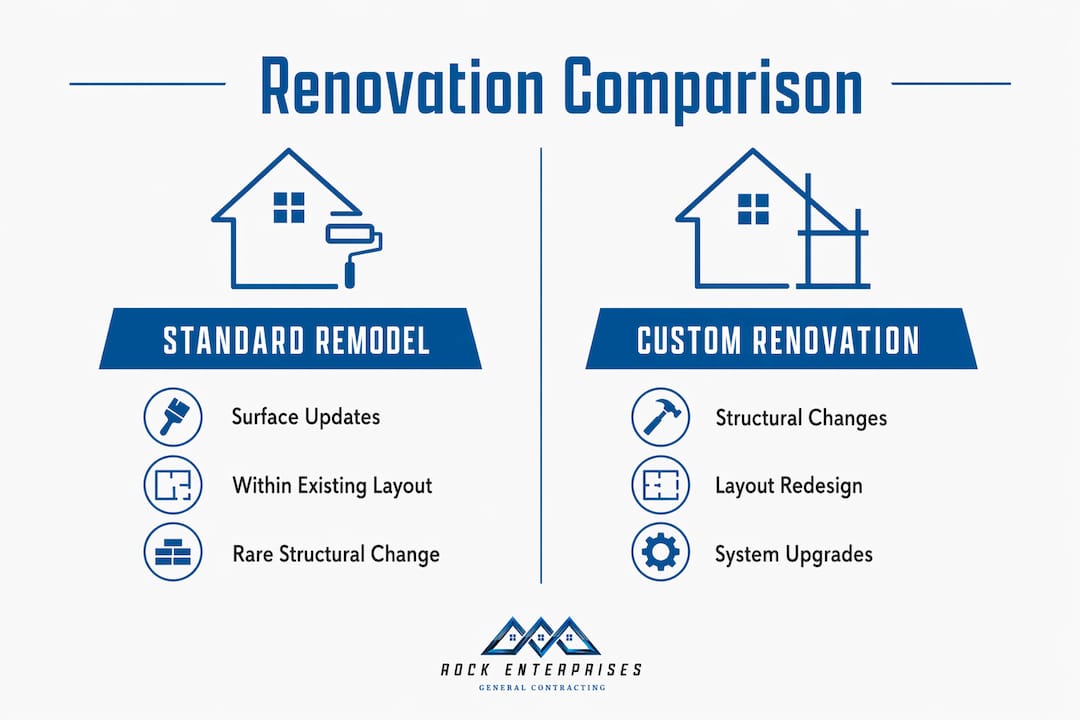
The core difference is scope. Standard remodels stay within existing walls and existing systems. Custom renovations change both.
| Feature | Standard remodel | Custom renovation |
|---|---|---|
| Structural changes | Rarely | Common |
| Floor plan alterations | No | Yes |
| Architectural design required | No | Yes |
| Permit complexity | Low | High |
| MEP system upgrades | Partial | Full |
| Timeline | Weeks | Months |
A standard kitchen remodel replaces cabinets, countertops, and appliances within the existing layout. A custom kitchen renovation might move the sink to a kitchen island, relocate a load-bearing wall, and upgrade the electrical panel to handle new appliances. The second project requires an architect, a structural engineer, and multiple permit approvals.
Custom renovations involving structural changes legally require coordination with architects and structural engineers to comply with safety codes. Skipping that step causes permit rejections and costly mid-project corrections. Budget and timeline both expand significantly in custom work. Homeowners should plan for months, not weeks, and build contingency funds into every budget.
Pro Tip: Get your structural engineer and architect involved before you hire a general contractor. Their drawings determine what the contractor bids on. Reversing that order almost always costs more money.
What is the custom renovation process?
The custom renovation process follows a design-first sequence. Skipping steps or reordering them is the most common cause of budget overruns and disappointing results.
-
Discovery and lifestyle assessment. A custom renovation begins with a discovery phase assessing daily routines and long-term goals rather than jumping to materials selection. You answer questions about how you cook, how many people use each bathroom, whether you work from home, and how you expect your household to change over the next decade.
-
Architectural design and layout planning. An architect translates your lifestyle assessment into floor plans. This stage locks in room relationships, traffic flow, and structural changes before any demolition begins.
-
Engineering review and code compliance. A structural engineer reviews any load-bearing changes. The design team confirms compliance with local building codes in your municipality, whether that is Monmouth County, Ocean County, or elsewhere in New Jersey.
-
MEP coordination. Mechanical, electrical, and plumbing systems get redesigned to support the new layout. Custom renovations often modernize MEP systems behind walls, bringing plumbing, electrical, and HVAC to current codes during open-wall phases. This step is vital but frequently underestimated by homeowners.
-
Permit submission and approval. Drawings go to the local building department. Approval timelines vary by municipality and project complexity.
-
Construction and execution. Demolition, structural work, rough MEP installation, insulation, drywall, finishes, and fixtures follow in sequence. A licensed general contractor coordinates all trades.
-
Inspections and certificate of occupancy. Building inspectors review work at multiple stages. Final approval closes the permit and confirms the work meets code.
Pro Tip: Do not select tile, fixtures, or cabinetry until your floor plan is finalized. Choosing materials before layout is a common mistake that leads to returns, delays, and spaces that feel off even when the materials are beautiful.
What are the benefits of custom renovations?
Custom renovations deliver advantages that standard remodels cannot match because they address the root causes of dissatisfaction rather than the symptoms.
- Spaces built around your life. Custom remodeling is not about excessive complexity. It focuses on intentional design that simplifies spaces with purposeful elements. Homes that result from this process feel balanced and reduce visual clutter.
- Improved spatial flow and storage. Reconfiguring a layout eliminates the dead hallways, awkward corners, and wasted square footage that plague older homes. You gain usable space without adding square footage.
- System upgrades that prevent future problems. The building envelope, including windows, insulation, and R-value upgrades, is crucial during custom renovations to enhance energy efficiency. Addressing these upgrades during renovation prevents future comfort and energy problems that are expensive to fix after walls are closed.
- Reduced need for future repairs. Intentional, upfront planning reduces complexity and costs because every renovation decision is made before demolition rather than fixing problems mid-project. Patchwork repairs compound over time. A well-planned custom renovation eliminates the conditions that create them.
- Long-term satisfaction. Owners who prioritize layout and function over materials achieve more lasting satisfaction in their renovations. Trends change. A kitchen designed around how you cook will still work for you in fifteen years regardless of what cabinet styles are popular.
What should homeowners consider when planning a custom renovation?
Planning a custom renovation requires honest answers to questions most homeowners skip.
- Verify structural soundness first. Custom renovations only make sense if the home’s structure is sound, the location is desirable, and the existing layout no longer serves the homeowner’s lifestyle. Misaligned renovations yield poor returns on investment. A structural inspection before design work begins saves money and prevents surprises.
- Understand legal requirements. Many jurisdictions require licensed architects to stamp drawings for structural changes. Confirm what your local building department requires before hiring anyone. Working with a licensed general contractor who knows local permit requirements protects you from costly compliance failures.
- Budget for systems, not just finishes. Most homeowners budget for what they can see. MEP upgrades, structural work, and building envelope improvements are invisible after completion but account for a large share of total project cost. Build a contingency of at least 15 percent into your budget for unforeseen conditions inside walls.
- Prioritize design coordination. Hiring trades independently without a coordinating general contractor produces patchwork results. Each trade optimizes for its own work without considering how it affects the others. A single point of coordination prevents conflicts between systems.
- Select contractors based on process, not price. The lowest bid rarely reflects the full scope of a custom renovation. Ask contractors how they handle design coordination, permit management, and mid-project changes. Their answers reveal whether they understand custom renovation work or are treating it like a standard remodel.
Pro Tip: Review a contractor’s completed renovation projects before signing anything. Photos of finished work show craftsmanship. References from past clients tell you how the contractor handled problems.
Key Takeaways
A custom renovation succeeds when design-first planning, structural integrity, and system upgrades are treated as non-negotiable foundations rather than optional add-ons.
| Point | Details |
|---|---|
| Definition clarity | Custom renovation alters structure, layout, and systems. Standard remodeling updates surfaces within existing footprints. |
| Design-first sequence | Lifestyle assessment and floor plan approval must happen before any material selection or demolition. |
| Professional requirements | Structural changes legally require architects and engineers. Skipping them causes permit rejections and costly delays. |
| System upgrades matter | MEP and building envelope improvements are invisible after completion but determine long-term comfort and efficiency. |
| Planning protects your investment | Intentional upfront decisions reduce mid-project changes and prevent the patchwork repairs that compound over time. |
Why design-first thinking changed how I see renovation work
Most homeowners walk into a renovation conversation talking about countertops. They have a Pinterest board full of quartz slabs and cabinet hardware. That is the wrong starting point, and I have seen it derail projects that had real potential.
The homeowners who end up most satisfied are the ones who spend the first month talking about how they live, not what they want things to look like. Where does the family actually gather? Is the current kitchen layout fighting against how you cook? Does the master bathroom need two sinks or would one sink and more counter space serve you better? Those answers drive layout decisions. Layout decisions drive everything else.
Custom renovation is not about spending more money to get fancier materials. It is about solving the right problems in the right order. A thoughtfully planned renovation of a modest home will outlast and outperform an expensive renovation that skipped the design phase. The full-service renovation process exists precisely because the coordination between design, structure, and systems is where most projects either succeed or fall apart.
— ryan
How Rockenterprisecontracting approaches custom home renovations
Rockenterprisecontracting is a licensed, family-owned general contracting company based in Shrewsbury, NJ, serving homeowners across Monmouth and Ocean County. The owner personally oversees every project, which means the person responsible for quality is on-site, not managing from an office. Rockenterprisecontracting holds a 5.0-star rating on Thumbtack and a 100 percent positive feedback score across completed projects.

Rockenterprisecontracting handles custom kitchens, bathroom renovations, tile work, and full home remodels with transparent pricing and hands-on craftsmanship. If you are ready to move from concept to a concrete plan, explore the full range of personalized renovation services or review the renovation planning guide to understand what a well-coordinated project looks like from start to finish.
FAQ
What does custom renovation mean in simple terms?
A custom renovation is a full transformation of a home’s structure, layout, and systems designed around the homeowner’s specific lifestyle. It goes beyond cosmetic updates to include architectural design, structural changes, and MEP system upgrades.
How is custom remodeling different from a standard remodel?
Standard remodeling updates surfaces and finishes within an existing floor plan. Custom remodeling changes the floor plan itself, often moving walls, relocating plumbing, and upgrading electrical and HVAC systems to support the new layout.
Do I need an architect for a custom renovation?
Yes, in most cases. Custom renovations involving structural changes legally require coordination with licensed architects and structural engineers to comply with local building codes and obtain permits.
What is the first step in the custom renovation process?
The first step is a discovery and lifestyle assessment. This phase identifies how you use your home daily and what functional problems the renovation needs to solve before any design or material decisions are made.
Are custom renovations worth the investment?
Custom renovations are worth the investment when the home’s structure is sound, the location is desirable, and the existing layout no longer fits the homeowner’s lifestyle. Misaligned renovations tend to yield poor returns, so alignment between scope and need is the deciding factor.