
Most homeowners assume a contractor warranty automatically covers everything for one year. That assumption gets people into trouble. Understanding what is a contractor warranty, what it actually covers, and how long it lasts can mean the difference between a free repair and an expensive dispute. The industry term you’ll hear most often is a workmanship warranty, which refers specifically to the contractor’s promise to stand behind their labor and installation quality. This guide breaks down the types, durations, legal nuances, and claim process so you can walk into any renovation project fully protected.
Table of Contents
- Key Takeaways
- What is a contractor warranty, exactly
- How long contractor warranties typically last
- How to file a warranty claim without losing your rights
- What homebuyers and investors need to know
- Contractor warranties vs. manufacturer warranties
- My honest take on contractor warranties
- Work with a contractor who stands behind their work
- FAQ
Key Takeaways
| Point | Details |
|---|---|
| Workmanship vs. manufacturer | Contractor warranties cover labor defects; manufacturer warranties cover product defects. |
| No universal one-year rule | Warranty duration depends on your contract and state law, not a single industry standard. |
| Implied warranties exist by law | Even without written terms, the law may protect you from hidden defects after a project. |
| Written claims matter | Submitting warranty claims in writing with clear defect descriptions protects your legal rights. |
| Transferability affects resale value | Some warranties follow the property; others are tied to the original owner only. |
What is a contractor warranty, exactly
A contractor warranty, formally called a workmanship warranty, is the contractor’s written or implied promise to repair or correct defects that result from their labor and installation techniques. It does not cover the materials themselves. That distinction matters more than most homeowners realize.
Here is the clearest way to think about it. A contractor warranty covers labor and installation quality, not the products used. So if your tile cracks because the contractor applied grout incorrectly, that falls under the workmanship warranty. If the tile itself was defective from the factory, that is a manufacturer warranty claim, not a contractor claim.
There are four types of warranties you will encounter on a renovation project:
- Workmanship warranty: Covers defects caused by the contractor’s labor or installation methods. This is the most common type and the one you should negotiate explicitly in your contract.
- Manufacturer warranty: Issued by the product maker and covers material defects. Think appliances, roofing shingles, or tile products.
- Express warranty: Any warranty explicitly stated in writing, whether in the contract or a separate document. These are the clearest and easiest to enforce.
- Implied warranty: A legal protection that exists even without a written agreement. Implied warranties protect homeowners from latent defects that were not discoverable during a normal inspection.
The contract language defining these distinctions is where most disputes begin. A contract that says “we warranty our work for one year” without specifying what counts as a workmanship defect versus a product defect is an invitation for conflict.
Pro Tip: Before signing any contract, ask the contractor to define in writing what triggers a warranty claim and what is excluded. Vague language like “defective work” without examples will cost you later.
How long contractor warranties typically last
The one-year workmanship warranty is the most common standard in residential construction, but it is not universal or legally mandated in most states. Typical workmanship warranties run about one year, while specialty trades often go longer. Roofing contractors frequently offer two-year warranties on labor, and some builders provide ten-year structural warranties on new construction.

Here is how warranty periods break down across common trades:
| Trade | Typical Warranty Period | Coverage Scope |
|---|---|---|
| General remodeling | 1 year | Labor and installation defects |
| Roofing (labor only) | 1 to 2 years | Installation, flashing, sealing |
| Structural work | 5 to 10 years | Foundation, framing, load-bearing elements |
| Plumbing and electrical | 1 year | Installation and connections |
| Tile and flooring | 1 year | Adhesion, grout, leveling |
| HVAC installation | 1 to 2 years | System installation and connections |
State law adds another layer of complexity. No universal one-year warranty mandate exists across all states. North Carolina is a good example: many homeowners there believe a one-year mandatory warranty applies to all construction work, but that is a myth. What actually exists is an implied warranty of workmanship, which is a different and often broader protection. The duration and scope of your actual coverage depends on your contract terms and your state’s statutes.
Contract law allows parties to negotiate warranty scope and duration, and some contracts even attempt to exclude implied warranties entirely. That flexibility is useful for contractors but requires homeowners to read every line carefully.
Pro Tip: Always confirm in writing when the warranty period starts. Some contracts trigger the clock from project completion; others start from final payment. That difference could cost you weeks of coverage.
How to file a warranty claim without losing your rights
Filing a warranty claim incorrectly is one of the most common ways homeowners lose coverage they are entitled to. The process is more formal than most people expect.
- Document the defect immediately. Take dated photos and video. Write a clear description of what you see, when you first noticed it, and how it affects the use of the space.
- Review your contract before contacting anyone. Confirm the defect falls within the warranty period and matches the coverage scope described in the agreement.
- Submit written notice to the contractor. A text message is not enough. Send an email or certified letter describing the defect, your contract reference, and the remedy you are requesting. Warranty claims require written notification with a detailed defect description, and failure to follow this process can void your claim entirely.
- Allow reasonable time for response. Most contracts specify a response window. If yours does not, 10 to 14 business days is a reasonable standard.
- Escalate if needed. If the contractor refuses or ignores the claim, your options include mediation, your state’s contractor licensing board, or small claims court depending on the dollar amount.
The most common disputes arise over whether a problem is a workmanship defect or a product defect. A contractor will often argue that cracked caulk or peeling paint is a material failure, not a labor issue. Ambiguous contract terms create arguments over coverage instead of focusing on actually fixing the problem. Having specific defect categories defined in your contract eliminates that back-and-forth.
Pro Tip: Keep a dedicated folder, digital or physical, for every document related to your renovation: the contract, change orders, receipts, inspection reports, and all warranty claim correspondence. If a dispute goes to court, this paper trail is your strongest asset.
What homebuyers and investors need to know
If you are buying a recently renovated property or investing in fix-and-flip real estate, contractor warranties affect your risk profile in ways most buyers overlook.
The biggest question is transferability. Warranty transferability affects property value and buyer protection during resale. Some warranties are tied to the original owner and expire the moment the property changes hands. Others are attached to the property itself and transfer automatically. You need to know which type you are dealing with before closing.
Beyond transferability, implied warranties offer a layer of protection that many investors do not know exists. Implied warranties of workmanship can extend to subsequent buyers for latent defects, meaning hidden problems not visible during a standard inspection. The Texas Supreme Court confirmed this principle, ruling that implied warranty protections benefit all buyers, not just the original client.
Here are the key questions to ask any contractor before signing:
- Does your workmanship warranty transfer to a new owner if I sell the property?
- What specific defects are covered, and which are excluded?
- When does the warranty period begin, and what triggers a valid claim?
- Do you carry liability insurance that would cover defects beyond the warranty period?
- Are manufacturer warranties for materials assigned to me in writing at project completion?
Getting clear answers to these questions before work begins separates informed homeowners and investors from those who discover the gaps only after something goes wrong.
Contractor warranties vs. manufacturer warranties
These two types of protection are often confused, and that confusion leads to rejected claims. Understanding the difference is straightforward once you know where each warranty originates.
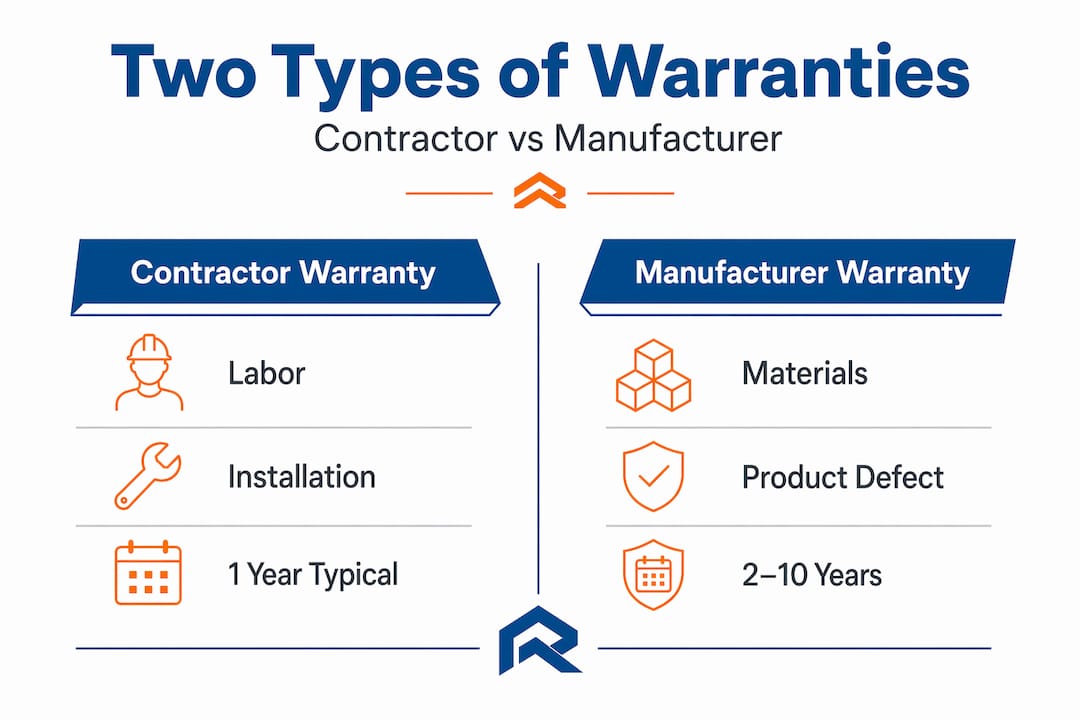
| Feature | Contractor Warranty | Manufacturer Warranty |
|---|---|---|
| Who issues it | The contractor | The product manufacturer |
| What it covers | Labor and installation defects | Product material defects |
| Example claim | Tile not properly set, causing cracking | Tile glazing defect from the factory |
| Duration | Typically 1 to 2 years | Varies widely, 1 to lifetime |
| Who to contact | Your contractor | Manufacturer’s customer service |
Manufacturer warranties do not cover improper installation errors. This is the critical point. If a contractor installs a water heater incorrectly and it fails, the manufacturer will deny the claim because the product itself was not defective. The contractor is responsible. Both warranties work together to give you full coverage, but only if you know which one applies to your specific problem.
My honest take on contractor warranties
I have worked on enough renovation projects to tell you that the one-year warranty assumption is the single biggest source of homeowner frustration after a project closes. People sign contracts without reading the warranty section carefully, assume they are covered, and then discover the hard way that the language was too vague to enforce.
What I have learned is that clear contract language is not a legal formality. It is the entire foundation of your protection. A contract that spends two pages on payment schedules and three sentences on warranty coverage is a contract written to protect the contractor, not you. I have seen disputes over cracked grout drag on for months because neither party could agree on whether it was a workmanship issue or a product issue. That ambiguity was entirely preventable.
The other thing I want to be direct about: following proper claim submission protocols is not bureaucratic red tape. It is how you preserve your legal rights. Homeowners who call their contractor, get a verbal promise to fix something, and never follow up in writing often find themselves with no recourse when that promise is not kept. Document everything. Every time.
My strongest advice is to treat the warranty section of any contract as seriously as the price. Read it, ask questions, and negotiate specific language before you sign. Understanding your construction project protections before work begins is what separates a smooth renovation from a costly dispute.
— ryan
Work with a contractor who stands behind their work
When you understand what contractor warranties cover and how they work, the next step is finding a contractor whose warranty commitments are actually worth something.

Rockenterprisecontracting is a licensed, family-owned general contractor serving Monmouth and Ocean County, NJ, with a 5.0-star rating and 100% positive feedback on Thumbtack. Every project comes with a written workmanship warranty and a contract that spells out exactly what is covered, when coverage begins, and how claims are handled. No vague language. No surprises after the job is done. Whether you are planning a kitchen or bathroom renovation or a larger home transformation, you can explore the full scope of services and warranty commitments at the Rock Enterprises renovation guide. Get in touch today to talk through your project with a contractor who takes their warranty as seriously as their craftsmanship.
FAQ
What does a contractor warranty cover?
A contractor warranty covers defects caused by the contractor’s labor and installation methods. It does not cover product or material defects, which fall under the manufacturer’s warranty.
How long does a contractor warranty last?
Most workmanship warranties last one year, though roofing and structural work often carry longer terms of two to ten years. The actual duration depends on your contract and state law, not a universal standard.
Is a one-year contractor warranty required by law?
No. There is no federal law mandating a one-year contractor warranty, and most states do not require one either. Coverage depends on your written contract and any implied warranties that exist under your state’s statutes.
Can a contractor warranty transfer to a new homeowner?
Some warranties transfer with the property; others are tied to the original owner only. Always confirm transferability in writing before purchasing a renovated property or selling your home.
What is the difference between an express and an implied warranty?
An express warranty is explicitly stated in your contract. An implied warranty is a legal protection that exists automatically under state law, even if nothing is written, and typically covers latent defects not visible during inspection.
Recommended
- Blog – Rock Enterprises | General Contractor Shrewsbury NJ
- Local Home Improvement Insights: Maximizing Your Property’s Potential – Rock Enterprises | General Contractor Shrewsbury NJ
- Building Your Dream Home: The Custom Home Construction Journey with Rock Enterprises – Rock Enterprises | General Contractor Shrewsbury NJ
- Effective Project Management in Construction: Key Strategies for Success – Rock Enterprises | General Contractor Shrewsbury NJ