
TL;DR:
- Hiring a licensed insured contractor ensures legal authorization and financial protection during renovation projects. Verification of licenses and insurance should be quick and thorough to prevent liability and guarantee quality work. Bonding, insurance, and permits each provide distinct protections that homeowners need for safe and compliant remodeling.
A licensed insured contractor is defined as a professional certified by a state licensing board to legally perform construction work, who also carries liability and workers’ compensation insurance protecting you from financial loss during a renovation. Understanding what is a licensed insured contractor before you hire separates a protected project from a costly mistake. Licensed contractors meet state competency requirements, carry the right insurance policies, and often hold a surety bond that gives you legal recourse if something goes wrong. In some states, that access extends to recovery funds reimbursing homeowners up to $30,000 for substandard work or unpaid judgments. That safety net disappears the moment you hire someone without proper credentials.
What does it mean to be a licensed contractor?
A contractor license is a state-issued authorization confirming that a professional has passed trade and business exams and met documented experience requirements. This is not the same as a general business license. A business license only confirms a company exists for tax purposes and provides zero consumer protection. A contractor license requires trade-specific knowledge, safety compliance, and financial responsibility.
Licensing exams typically cover two areas:
- Trade knowledge: Building codes, construction methods, and safety regulations specific to the work being performed.
- Business and law: Contract law, lien rights, insurance requirements, and financial management.
Licenses also fall into distinct categories. Specialty licenses cover a single trade, such as plumbing, electrical, or HVAC. General contractor licenses authorize the coordination of multiple unrelated trades on one project. Hiring a plumber with only a general license for complex electrical work, or vice versa, creates a compliance gap that can void your homeowner’s insurance.
Licensing requires documented skills and financial responsibility; registration alone is insufficient. Always verify that the license is active, correctly classified for your project type, and issued by your state’s official licensing board.
Pro Tip: Ask for the contractor’s license number before signing anything, then look it up yourself on your state licensing board’s public database. A legitimate contractor will hand it over without hesitation.
What insurance coverage should a licensed insured contractor carry?
Insurance is what transfers financial risk away from you and onto the contractor’s policy. General liability protects property and people; workers’ compensation covers injuries to construction workers on your property. Both policies are non-negotiable for any renovation project.
Here is what each policy actually covers:
- General liability insurance: Pays for property damage your contractor causes, such as a broken pipe flooding your basement, and covers bodily injury to third parties on the job site.
- Workers’ compensation insurance: Covers medical bills and lost wages for any worker injured on your property. Without it, you could be personally liable for those costs.
- Completed operations coverage: Extends liability protection after the job is finished, covering damage that surfaces from the completed work.
Unlicensed workers rarely carry insurance covering residential claims. That means a worker who falls off a ladder in your backyard could sue you directly if the contractor has no workers’ comp policy.
Pro Tip: Never accept a photocopy of an insurance certificate. Ask for the insurer’s contact information and call to verify the policy is active and covers your specific project scope. Policies can lapse between the time a certificate is printed and the day work begins.

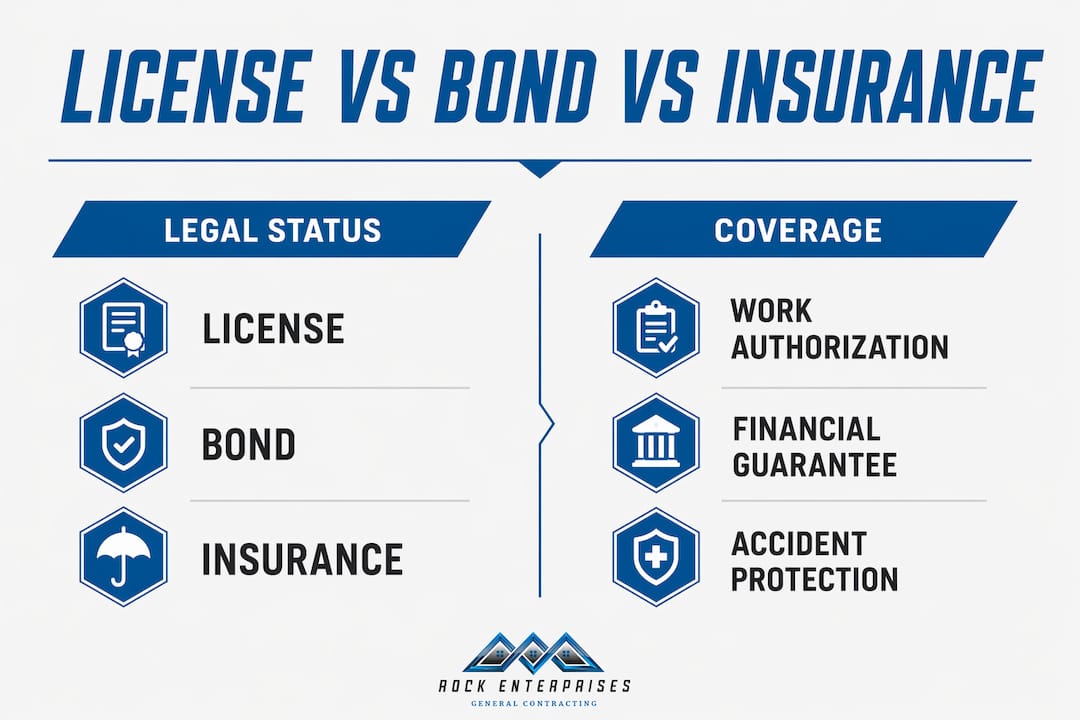
What is the difference between licensed, bonded, and insured?
Many homeowners treat these three terms as interchangeable. They are not. Each provides a distinct layer of protection, and you need all three working together.
Many homeowners misinterpret “licensed” as inclusive of bonding or insurance, but bonding is a separate financial safety net for contract fulfillment. Here is how the three credentials compare:
| Protection Type | What It Covers | Who It Protects |
|---|---|---|
| License | Confirms legal authorization and competency to perform the work | Homeowner and public |
| Insurance | Covers property damage, injuries, and accidents during the project | Homeowner and workers |
| Surety bond | Guarantees contract fulfillment; pays out if contractor defaults | Homeowner |
Bonding works differently from insurance. A surety bond financially backs contractors and screens out those lacking financial stability. If a contractor abandons your kitchen remodel halfway through, you can file a claim against the bond. The surety company pays you, then recovers that money from the contractor. This accountability loop is what makes bonding meaningful, not just a formality.
Bonding is often required by state law for contractors above a certain project value threshold. However, bond amounts vary widely by state and may not cover the full cost of a failed project. Bonding supplements insurance and licensing. It does not replace either one.
Why hiring a licensed insured contractor matters for your renovation
Hiring a properly credentialed contractor is not just about peace of mind. It has direct legal and financial consequences for your home.
Many jurisdictions require permits and licensed professionals for projects exceeding $1,000 in labor and materials. Skipping this step can result in fines, forced demolition of unpermitted work, and complications when you sell the home. Your homeowner’s insurance policy may also deny claims for damage caused by unpermitted work.
The practical benefits of hiring a licensed and insured contractor include:
- Legal permit acquisition: Licensed contractors pull permits in their name, keeping you legally protected and ensuring inspections happen at the right stages.
- Code compliance: Work must meet local building codes, which protects your home’s structural integrity and resale value.
- Personal liability protection: If a worker is injured on your property and the contractor carries workers’ comp, you are not responsible for medical costs.
- Access to state recovery funds: Some states maintain funds that reimburse homeowners when licensed contractors produce substandard work or fail to pay judgments.
- Workmanship accountability: Licensed contractors can lose their license for poor work, giving them a professional incentive to get it right.
Owner-pulled permits shift all legal liability to you and remove access to state arbitration or guaranty funds. If a contractor asks you to pull your own permit, treat it as a serious red flag.
How to verify a contractor’s license and insurance before hiring
Verification takes less than 30 minutes and can save you from a financial disaster. Follow these steps before signing any contract:
- Request the license number in writing. Ask for the contractor’s full name, business name, and license number before any conversation about pricing.
- Check the state licensing board database. Most states publish a free, searchable database. Confirm the license is active, not expired, and classified for your project type. New Jersey homeowners can use the NJ contractor verification guide for a step-by-step walkthrough.
- Request a certificate of insurance. Ask for both general liability and workers’ compensation certificates. The certificate should list your name as an additional interested party.
- Call the insurer directly. Do not rely on the certificate alone. Contact the insurance company to confirm the policy is current and covers the scope of your project.
- Watch for owner-pulled permits. If the contractor suggests you pull the permit yourself, decline. This shifts liability to you and removes your access to state consumer protections.
- Cross-reference with the NJ homeowner checklist. A structured checklist helps you confirm every credential before work begins.
For homeowners in Utah or other states, resources like contractor licensing in Utah illustrate how licensing standards and verification processes work across different jurisdictions, which is useful context when evaluating any contractor’s credentials.
Key Takeaways
A licensed insured contractor provides legal authorization, financial protection, and workmanship accountability that unlicensed workers simply cannot offer.
| Point | Details |
|---|---|
| Licensing confirms competency | State-issued licenses require passing trade and business exams, not just registering a business. |
| Insurance protects your finances | General liability and workers’ comp transfer accident costs away from you to the insurer. |
| Bonding is a separate guarantee | A surety bond covers contract default and is distinct from insurance or licensing. |
| Permits matter legally | Licensed contractors pull permits in their name, keeping you compliant and protecting resale value. |
| Verification is your responsibility | Always check license status and call the insurer directly before signing any contract. |
Why I tell every homeowner to verify before they trust
The single biggest mistake I see homeowners make is assuming that a friendly referral and a reasonable quote are enough. They are not. A contractor can be personable, punctual, and still be operating without a valid license or an active insurance policy.
Homeowners who skip verification often discover the problem only after something goes wrong. A worker gets hurt. A wall gets damaged. The contractor disappears. At that point, the homeowner is holding the liability because there is no policy to file against and no licensing board to complain to.
The other misconception I run into constantly is that a business card or a website makes someone legitimate. Hiring unlicensed or uninsured contractors exposes you to personal liability for accidents, injuries, and property damage, with no access to recovery funds or legal recourse. A professional website does not change that.
What actually works is simple: ask for the license number, look it up, and call the insurer. Contractors who have nothing to hide hand over that information immediately. The ones who stall or deflect are telling you everything you need to know.
— ryan
Rockenterprisecontracting: licensed, insured, and ready for your renovation
Rockenterprisecontracting is a fully licensed and insured general contracting company based in Shrewsbury, NJ, serving homeowners across Monmouth and Ocean County. The owner personally oversees every project, which means you get direct accountability from start to finish, not a rotating crew of subcontractors you have never met.

Whether you are planning a kitchen remodel or a full bathroom renovation, Rockenterprisecontracting brings the credentials, the permits, and the craftsmanship to protect your home and your investment. Their 5.0-star rating on Thumbtack and 100% positive feedback score reflect what proper licensing and hands-on ownership actually produce. If you want to see how the right contractor can improve your home’s comfort and value, start with their guide on how renovation increases home comfort.
FAQ
What is a licensed insured contractor?
A licensed insured contractor is a professional authorized by a state licensing board to perform construction work, who also carries general liability and workers’ compensation insurance. These credentials protect homeowners from financial liability, property damage costs, and worker injury claims.
Why should I hire a licensed contractor instead of an unlicensed one?
Licensed contractors can legally pull permits, must follow building codes, and give you access to state recovery funds if work is substandard. Unlicensed workers leave you personally liable for accidents and provide no legal recourse.
What is the difference between bonded and insured?
Insurance covers accidents and property damage during the project. A surety bond is a financial guarantee that the contractor will complete the work as agreed. If they default, you can file a claim against the bond.
How do I verify a contractor’s license?
Request the contractor’s license number and check it against your state’s official licensing board database. Confirm the license is active and classified for your specific project type before signing any contract.
Do licensed contractors need to pull permits?
Yes. Licensed contractors are legally required to obtain permits for most projects exceeding $1,000 in labor and materials. If a contractor asks you to pull the permit yourself, that is a red flag indicating they may not hold a valid license.