
TL;DR:
- Historic home renovation in New Jersey involves repairing and updating properties while preserving their historic features under state and federal standards. Homeowners must adhere to strict approval processes, including obtaining a Certificate of Appropriateness and signing rehabilitation agreements, to qualify for financial incentives like tax credits. Thorough planning, working with experienced professionals, and conducting detailed assessments are essential for successful and compliant renovations.
Historic home renovation in New Jersey is defined as the process of repairing, updating, and adapting a period property while preserving its architectural character and cultural significance under state and federal preservation standards. The industry term for this work is “rehabilitation,” though homeowners commonly search for what is historic home renovation NJ when they first encounter the process. The New Jersey Historic Preservation Office (HPO) and the Secretary of the Interior’s Standards govern how this work gets done. Local Historic Preservation Commissions add another layer of oversight at the municipal level. Programs like the NJEDA Historic Property Reinvestment Program and the federal 20% historic tax credit make the financial side more manageable for qualifying homeowners.
What is historic home renovation in NJ, and how does it work?
Historic home renovation in NJ covers any work on a property that holds local, state, or national historic designation. That includes homes listed on the New Jersey Register of Historic Places, the National Register of Historic Places, or those located within a recognized local historic district. The NJ Historic Preservation Office describes the goal as balancing heritage with modern living, meaning you do not have to sacrifice comfort to protect your home’s character.
The process differs from a standard remodel in one critical way: every significant change must align with preservation guidelines before a single nail goes in. Rehabilitation is the most common treatment for occupied homes. It allows updates for modern use while retaining historic features. Restoration, by contrast, returns a property to a specific historical period and is typically reserved for museum properties or landmark structures.
Homeowners in Monmouth and Ocean County frequently own Victorian, Colonial Revival, and Craftsman bungalow properties that qualify for these programs. Understanding which designation applies to your home determines which rules, reviews, and incentives apply to your project.
What are the essential regulations and approval processes for historic home renovations in NJ?
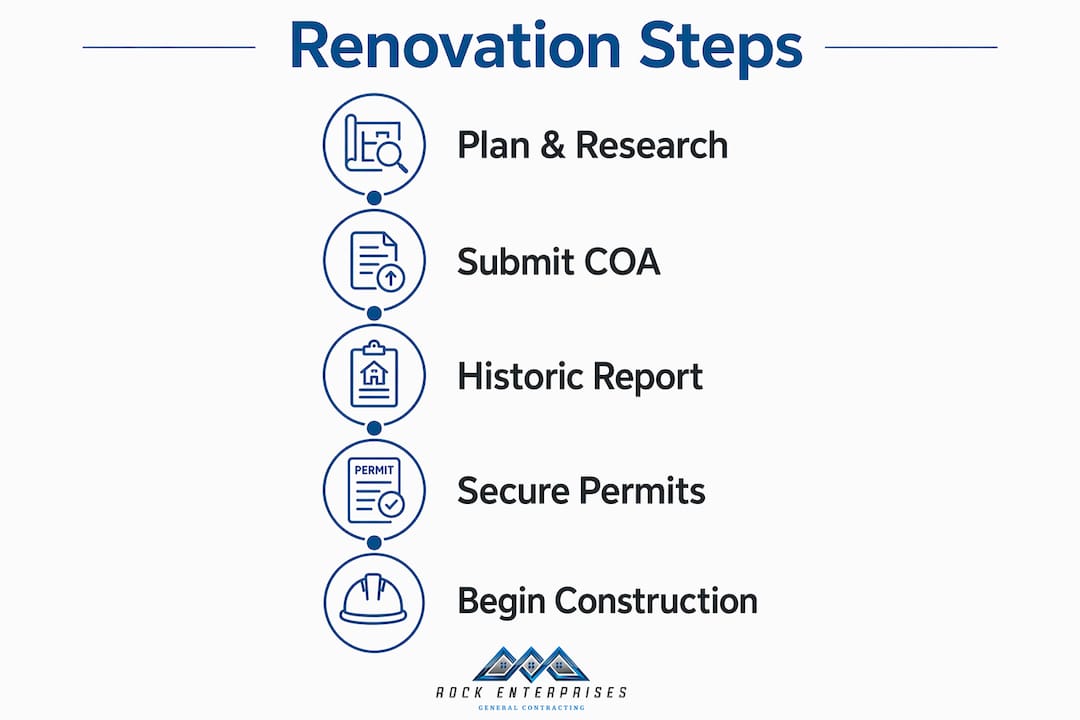
The approval process for historic home restoration in NJ follows a defined sequence, and skipping any step can delay or derail your project entirely.
-
Confirm your property’s designation. Check whether your home sits within a local historic district, holds individual landmark status, or appears on the state or national register. Each designation triggers different review requirements.
-
Apply for a Certificate of Appropriateness (COA). Exterior changes to designated historic properties require a COA from the local Historic Preservation Commission before permits or construction can begin. This applies to siding, windows, doors, roofing, and additions.
-
Attend the Historic Preservation Commission hearing. Most commissions meet monthly. You will present your plans, material samples, and photographs. The commission evaluates your proposal against the Secretary of the Interior’s Standards.
-
Obtain standard building permits. After COA approval, you apply for standard municipal building permits through your local planning or zoning board. Interior alterations generally do not require a COA, but they must still meet building codes.
-
Execute any required rehabilitation agreements. If you plan to apply for state or federal tax credits, you must sign a rehabilitation agreement with the relevant agency before construction starts.
-
Begin construction. Work proceeds under the approved scope. Inspections occur at standard intervals, and any scope changes require amended approvals.
Pro Tip: Review the renovation permit application process before your first commission meeting. Arriving with complete drawings and material specifications dramatically shortens review time.
The full approval timeline typically runs 60–120 days before construction can start. Build that window into your project schedule from day one.
How do historic tax credit and incentive programs support NJ homeowners?
Financial incentives make historic home restoration in NJ far more affordable than most homeowners expect. Two programs stand out as the most impactful.
The federal 20% historic tax credit applies to qualified rehabilitation expenditures on income-producing properties listed on the National Register. For homeowners who rent part of their property or use it for business purposes, this credit directly offsets federal tax liability dollar for dollar.
The NJEDA Historic Property Reinvestment Program targets a broader range of property types at the state level. Key eligibility rules include:
- Applicants must score at least 50 out of 100 on the program’s evaluation criteria to qualify.
- Work completed before submitting the application does not count toward eligible costs. That exclusion alone has cost homeowners thousands of dollars in lost credits.
- A signed rehabilitation agreement with the NJEDA must be in place before any construction begins.
- Photographic documentation of existing conditions is required at the application stage.
- The property must retain sufficient historic integrity to meet program standards.
Starting construction before securing approvals or executing rehabilitation agreements can forfeit eligibility for tax credits and funding programs entirely. That is the single most expensive mistake homeowners make in the NJ historic renovation process.
Pro Tip: Consult a preservation tax specialist before submitting any application. The NJEDA program has specific cost-allocation rules that differ from standard contractor billing.
What are best practices for planning and executing a historic home renovation in NJ?
Successful historic home renovation projects share one trait: thorough planning before any physical work begins. The following practices separate projects that sail through review from those that stall.

Partner with a preservation-experienced architect
A general architect may not know the Secretary of the Interior’s Standards well enough to design compliant details. Seek an architect with documented experience on historic properties in New Jersey. They will know which window profiles, mortar mixes, and siding profiles satisfy commission requirements.
Commission a Historic Structures Report
A comprehensive Historic Structures Report (HSR) with photographic documentation and treatment recommendations is critical to compliance. The HSR catalogs existing conditions, identifies significant historic fabric, and recommends treatment approaches for each building system. Without it, you are guessing at what to preserve and what to replace.
Use non-destructive investigation methods
Experts use non-destructive techniques like paint analysis, mortar sampling, dendrochronology, and ground-penetrating radar to understand a building’s history without damaging it. Paint analysis, for example, can reveal original color schemes and tell you which layers of material are historic. That information directly informs your commission presentation.
Address hazardous materials early
Lead paint and asbestos must be abated according to EPA and OSHA standards before any structural work begins. Older New Jersey homes built before 1978 almost certainly contain lead paint. Asbestos appears in floor tiles, pipe insulation, and roofing materials in homes built before 1980. Abatement adds cost and time, but it is non-negotiable.
Pro Tip: Use the licensed contractor checklist for NJ homeowners to verify that any contractor you hire carries the correct EPA Renovation, Repair, and Painting (RRP) certification before they touch a surface.
Balance authenticity with modern comfort
The NJ Historic Preservation Office explicitly supports integrating energy efficiency and modern systems into historic homes. You can add insulation, update electrical panels, and install HVAC systems without violating preservation standards, provided the work does not destroy historic fabric. The key is reversibility: changes should be undoable without damaging original material.
What distinguishes historic renovation from restoration, rehabilitation, and reconstruction in NJ?
The Secretary of the Interior’s Standards define four distinct treatment approaches for historic properties. Choosing the wrong one affects your tax credit eligibility and the scope of regulatory review.
| Treatment | Definition | NJ application | Tax credit eligibility |
|---|---|---|---|
| Preservation | Stabilizes and maintains existing historic form with minimal change | Ongoing maintenance of a landmarked home | Generally not eligible for rehabilitation credits |
| Rehabilitation | Updates for modern use while retaining historic character | Most occupied historic homes in NJ | Eligible for federal 20% credit and NJEDA program |
| Restoration | Returns property to a specific historical period | Museum properties, landmark interiors | Limited eligibility; strict documentation required |
| Reconstruction | Rebuilds a vanished or severely deteriorated structure | Rare; requires extensive historical evidence | Rarely eligible; high regulatory burden |
Rehabilitation is the right choice for the vast majority of NJ homeowners. It gives you the most flexibility to update kitchens, bathrooms, and mechanical systems while still qualifying for financial incentives. Restoration is appropriate only when you want to return a specific room or facade to a documented historical appearance and are prepared for the research and review that requires.
Choosing reconstruction is uncommon and carries the highest regulatory burden. The NJ HPO requires extensive historical evidence, including photographs, drawings, and written records, before approving any reconstructed element.
Key takeaways
Historic home renovation in NJ requires COA approval, a signed rehabilitation agreement, and a completed Historic Structures Report before construction begins, or homeowners risk losing tax credit eligibility entirely.
| Point | Details |
|---|---|
| COA is mandatory | Exterior changes to designated NJ historic properties require a Certificate of Appropriateness before permits are issued. |
| Pre-work kills incentives | Work done before submitting the NJEDA application does not count toward eligible costs and can disqualify the project. |
| HSR is non-negotiable | A Historic Structures Report documents existing conditions and guides compliant treatment decisions. |
| Rehabilitation is the standard | Most NJ homeowners should pursue rehabilitation, not restoration, to maximize flexibility and tax credit access. |
| Hazardous materials come first | Lead paint and asbestos abatement per EPA and OSHA standards must happen before any structural work begins. |
What I have learned from watching NJ homeowners navigate historic renovations
The biggest mistake I see is not starting construction too early. It is starting without a clear understanding of which designation applies to the property. A homeowner in a locally designated historic district faces a completely different review process than one whose home is only on the National Register. Those two situations require different architects, different commission presentations, and different application timelines.
The second pattern I notice is underestimating the value of the Historic Structures Report. Homeowners treat it as a bureaucratic hurdle. It is actually the most useful document on the project. A good HSR tells you exactly what you have, what is significant, and what you can change without triggering additional review. Skipping it to save money almost always costs more in revision fees and commission delays.
The third thing worth saying plainly: historic renovation is not a constraint on your home. It is a framework that protects the features that make your property worth owning in the first place. The whole-home renovation process for a historic property takes longer and costs more upfront, but the result is a home that holds its character and its value in ways that generic remodels simply do not.
Work with people who have done this before. The approval process rewards preparation, and preparation rewards experience.
— ryan
Rockenterprisecontracting: historic renovation expertise for NJ homeowners
Rockenterprisecontracting is a licensed, family-owned general contracting company based in Shrewsbury, NJ, with hands-on experience in the specific demands of period properties across Monmouth and Ocean County. The owner personally oversees every project, which matters when commission approvals and material authenticity are on the line.

If you own a historic home and want to understand how renovation can increase your home’s comfort without compromising its character, Rockenterprisecontracting is ready to walk through your options. The team brings a 5.0-star rating on Thumbtack and a 100% positive feedback score to every consultation. Reach out to schedule a project assessment and get a clear picture of what your renovation will actually involve.
FAQ
What is a Certificate of Appropriateness in NJ?
A Certificate of Appropriateness (COA) is a required approval from a local Historic Preservation Commission that authorizes exterior changes to a designated historic property before permits or construction can begin.
Can I update my kitchen or bathroom in a historic NJ home?
Yes. Rehabilitation standards allow modern updates to kitchens, bathrooms, and mechanical systems as long as the work does not destroy significant historic fabric and remains reversible.
What happens if I start work before getting approvals?
Starting construction before securing approvals or signing a rehabilitation agreement can disqualify your project from the NJEDA Historic Property Reinvestment Program and federal tax credits entirely.
How do I know which historic treatment applies to my home?
Most occupied NJ historic homes fall under rehabilitation, which allows modern updates while retaining historic character. Consult the historic home remodel checklist to confirm which designation and treatment apply to your specific property.
Do I need a Historic Structures Report for every renovation?
A Historic Structures Report is required for most projects seeking tax credits or regulatory approval. It documents existing conditions and provides treatment recommendations that guide compliant renovation decisions.