
TL;DR:
- Clear communication with your contractor through written project briefs and formal change orders helps ensure your renovation stays on time and on budget. Regular updates, detailed documentation, and early concern reporting prevent disputes and misunderstandings during the project. Building a solid communication plan and avoiding informal messages reduce legal risks and promote smoother renovations.
Clear communication with your contractor is the single most reliable way to keep a renovation on time, on budget, and free of disputes. When you communicate needs to your contractor in writing before work begins, you create a record that protects both sides. The National Association of Home Builders recognizes documented communication as a best practice for reducing cost overruns and timeline delays. This guide walks you through building a project brief, setting a communication schedule, handling changes formally, and avoiding the mistakes that derail most renovations.
How to communicate needs to your contractor with a strong project brief
A written project brief is the foundation of every successful renovation. It translates your goals into specific, quotable details before a contractor ever sets foot in your home. Without one, you are relying on memory and assumptions, and both will fail you at the worst possible moment.
A strong brief covers five core elements:
- What the problem is. Describe what you see, not what you think caused it. “The kitchen faucet drips constantly and the cabinet under the sink shows water stains” is far more useful than “the plumbing is bad.”
- Where exactly the work is. Name the room, the wall, and the specific fixture. “Master bathroom, north wall, the 36-inch vanity” leaves no room for guessing.
- Component details. Include brand names, model numbers, and approximate age where you know them. This helps the contractor quote accurately and order the right parts.
- Your budget ceiling. State the maximum you will spend. Contractors use this to scope the work realistically rather than proposing what they think you want to hear.
- Access and contact information. Specify who to call for entry, what hours are acceptable, and whether pets or children will be present.
A five-part written brief sent by email before work begins forms part of the contract trail and reduces the risk of disputes later. That email record is worth more than any handshake.
Pro Tip: Avoid technical jargon in your brief. Describe what you observe with your eyes, not what you think the technical fix is. Contractors respect clarity over attempted expertise.

When you discuss project requirements in writing upfront, you also make it easier to compare quotes from multiple contractors on equal terms.
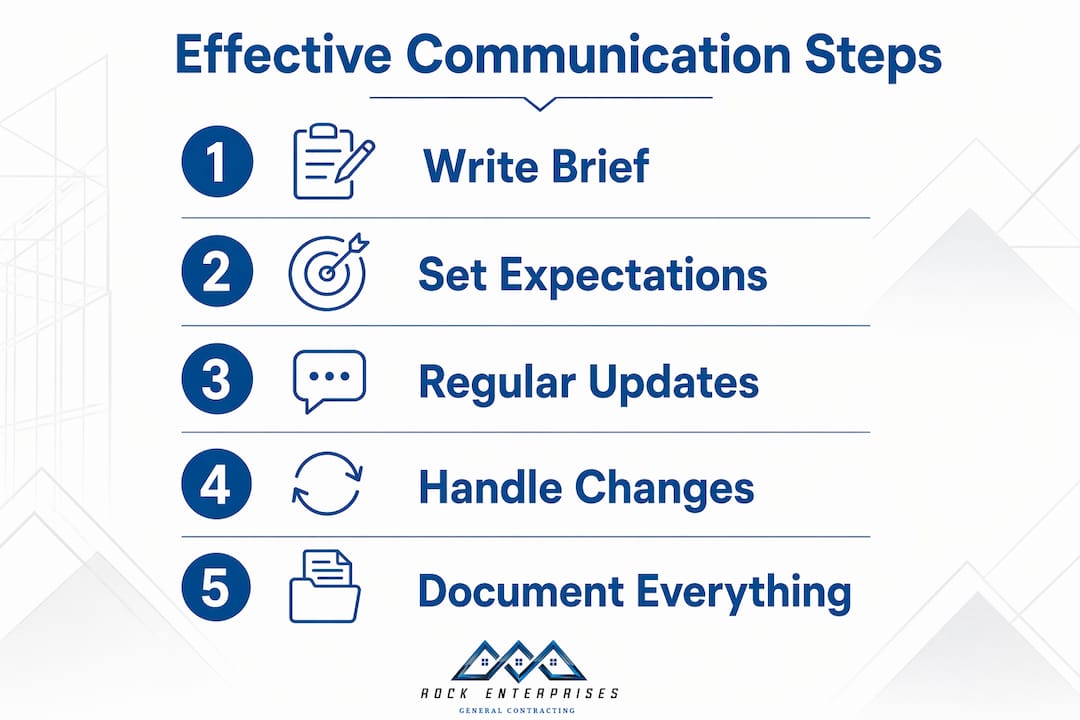
What should a contractor communication plan include?
Agreeing on a communication plan before work starts is just as important as the project brief itself. Deciding update frequency and format before work begins, and documenting that agreement, is a recognized best practice in contractor communication. Without this agreement, updates become sporadic and anxiety fills the gaps.
A solid communication plan covers:
- Update frequency. Weekly updates work well for most renovations. Daily check-ins suit fast-moving or complex projects.
- Preferred format. Email creates a written record. Phone calls are faster but need follow-up summaries. Project management platforms centralize everything in one place.
- Primary contacts. Name one person on your side and confirm who speaks for the contractor’s team. Multiple points of contact create confusion.
- Milestone meetings. Schedule a formal check-in at the start, at the midpoint, and before final sign-off. These meetings catch problems while there is still time to fix them cheaply.
Regular written updates with immediate notification of delays, scope changes, or cost changes are the clearest way to stay aligned day to day. That means you should not wait for the contractor to volunteer information. Build the expectation into your agreement from day one.
Pro Tip: Ask your contractor to send a brief Friday email each week summarizing what was completed, what comes next, and any open questions. This one habit cuts confusion and client anxiety dramatically.
Understanding the role of a project manager in your renovation can also clarify who owns communication responsibilities on larger jobs.
How should you handle changes and disputes with your contractor?
Scope changes are the number one source of renovation disputes. The way you handle them determines whether a disagreement becomes a minor correction or a costly legal conflict.
- Use a formal change order for every scope change. A change order documents the new work, the added cost, and the revised timeline. Change orders must be signed by both parties before additional work begins to be enforceable. Never let a contractor start extra work on a verbal “go ahead.”
- Confirm significant conversations in writing. When a problem arises, handle difficult conversations in person or by phone, then follow up immediately with a written summary of what was agreed. This removes ambiguity about tone and next steps.
- Never negotiate scope, pricing, or schedule changes over text. Informal messages are legally risky and easily misread. Text messages on construction projects carry legal ambiguity that formal written channels avoid entirely.
- Raise concerns promptly. Waiting until project completion to flag a problem removes your leverage. Reference the original project scope or contract when raising an issue so the conversation stays grounded in facts.
- Understand the difference between “approval” and “acceptance.” Approving a change order means you agree to the work and cost. Accepting completed work means you confirm it meets the agreed standard. Conflating the two creates disputes at final payment.
Pro Tip: When a problem surfaces, ask your contractor to restate their understanding of the issue and the proposed fix before any work proceeds. This one step closes more communication gaps than any other technique.
Knowing your renovation contract terms before disputes arise puts you in a far stronger position to resolve them quickly.
What tools help you document contractor communication?
Documentation is your legal safety net. Contemporaneous records like detailed change logs and daily logs with timestamps and audit trails are the most reliable way to resolve disputes when they arise.
| Communication method | Pros | Cons |
|---|---|---|
| Creates a written record, easy to search | Can be slow for urgent decisions | |
| Phone or in-person | Fast, good for sensitive conversations | No automatic record; needs follow-up summary |
| Text message | Convenient and quick | Legally ambiguous, easy to misinterpret |
| Project management platform | Centralizes all communication, approvals, and files | Requires both parties to adopt the tool |
Email wins for most homeowners because it is free, familiar, and creates a searchable record without extra setup. Project management platforms add value on larger renovations where multiple subcontractors are involved.
Maintaining timestamped daily logs that include weather conditions, work completed, and inspections meets the standard set by AIA A201, one of the most widely referenced construction contract frameworks in the United States. That standard exists because courts and arbitrators consistently rely on contemporaneous records over memory.
Pro Tip: After every phone call or site visit, send a short email to your contractor: “Following up on our conversation today, we agreed to X, Y, and Z.” This takes two minutes and creates a record that can save thousands.
Pairing good documentation with a clear renovation budget plan also reduces the chance of cost disputes escalating.
Common communication mistakes homeowners make with contractors
Most renovation problems trace back to a small set of avoidable communication errors. Recognizing them before your project starts is the fastest way to protect yourself.
- Relying on verbal agreements. A verbal promise is unenforceable. Every commitment about scope, cost, or timeline belongs in writing.
- Using text for important decisions. Texts feel fast and easy, but they create legal ambiguity and are easy to misread out of context.
- Waiting too long to raise concerns. A small issue flagged on day three costs far less to fix than the same issue raised at project completion.
- Skipping budget clarity. Failing to state your budget ceiling upfront leads contractors to propose work that exceeds what you can afford, wasting everyone’s time.
- Not confirming the contractor’s understanding. Asking builders to repeat their project understanding before work begins resolves misunderstandings that neither party knew existed.
- Missing scheduled updates. Skipping a weekly check-in once sets a precedent. Contractors read silence as approval.
- Sharing vague project details. “Update the bathroom” is not a brief. Specific details about fixtures, finishes, and budget produce accurate quotes and fewer surprises.
Pro Tip: At the start of the project and again after any change, ask your contractor to summarize what they will do, in what order, and by when. Their answer tells you immediately whether you are aligned.
Understanding renovation terms that affect your project also helps you communicate more precisely and avoid costly misunderstandings.
Key Takeaways
Clear scope documentation and structured check-ins from day one prevent delays, cost overruns, and disputes, leading to on-budget, on-time delivery.
| Point | Details |
|---|---|
| Write a detailed project brief | Cover the problem, location, components, budget ceiling, and access details before work begins. |
| Agree on a communication plan | Set update frequency, format, and primary contacts before the first day of work. |
| Use formal change orders | Require signed change orders before any additional work starts to avoid cost disputes. |
| Document everything in writing | Follow every phone call or site visit with a written summary sent by email. |
| Raise concerns early | Flag problems as soon as they appear; waiting until completion removes your leverage. |
What I have learned from watching renovations go wrong
After years of working closely with homeowners on renovation projects, the pattern is always the same. The projects that go sideways are not the ones with the hardest technical challenges. They are the ones where communication broke down in the first two weeks.
The most common scenario I see: a homeowner and contractor have a great first meeting, shake hands, and assume they are on the same page. Three weeks in, the homeowner expected one thing and the contractor built another. Both parties are frustrated, and neither is entirely wrong. The problem was never the work. It was the gap between what was said and what was documented.
Technology has made this both easier and harder. Email and project management tools give you a clear record. But text messages have created a false sense of communication. A quick text feels like a decision. Legally and practically, it rarely is.
The homeowners who get the best results treat their contractor as a partner, not a vendor. They ask questions. They confirm understanding. They send follow-up emails without apology. They do not wait for problems to announce themselves. That posture, more than any tool or template, is what separates a smooth renovation from a stressful one.
— ryan
Rockenterprisecontracting keeps you informed at every stage
Rockenterprisecontracting is a licensed, family-owned general contracting company based in Shrewsbury, NJ, with a 5.0-star rating on Thumbtack and a 100% positive feedback score. Every project is personally overseen by the owner, which means you always have a direct line to the person responsible for your home.

Rockenterprisecontracting builds structured communication into every renovation from the first conversation. Homeowners across Monmouth and Ocean County get transparent pricing, written updates, and a team that treats their home with care. If you want to see what that looks like in practice, explore how renovation improves home comfort and what personalized renovation services can do for your space.
FAQ
What is the best way to communicate needs to your contractor?
Send a written project brief by email before work begins, covering the problem, location, component details, budget ceiling, and access information. Written communication creates a record that protects both parties and forms the basis of an accurate quote.
Why should I avoid text messages for contractor decisions?
Text messages carry legal ambiguity and are easily misinterpreted out of context. Formal written channels like email are recommended for all scope, pricing, and schedule discussions to avoid disputes.
What is a change order and when do I need one?
A change order is a written document that records any change to the original project scope, cost, or timeline. Both parties must sign it before additional work begins for it to be enforceable.
How often should I expect updates from my contractor?
Weekly written updates are the standard for most renovations, with immediate notification required for delays, cost changes, or material substitutions. Agree on this frequency before work starts and put it in writing.
What records should I keep during a renovation?
Keep copies of all emails, contracts, change orders, and written summaries of phone or in-person conversations. Timestamped daily logs that note work completed and inspections provide the strongest legal protection if a dispute arises.