
A renovation scope is a detailed, written description of every task, material, and procedure involved in your remodeling project. Think of it as the contract’s backbone: it tells your contractor exactly what to build, what to buy, and what to leave alone. Without one, you are essentially handing someone a blank check and hoping for the best.
A complete renovation scope typically covers:
- Work tasks: Every specific job, organized by trade and phase (demolition, framing, plumbing, electrical, finish work)
- Material specifications: Brands, models, grades, colors, and quantities for every product going into the project
- Explicit exclusions: Items that will NOT be done, stated clearly in writing
- Project constraints: Budget limits, timeline, HOA restrictions, permit requirements
- Acceptance criteria: The standard of quality or completion that triggers sign-off
- Change order process: A written procedure for approving any additions or modifications before work begins
One thing worth clarifying upfront: a scope of work is not an estimate. An estimate predicts cost; the scope describes what that cost covers. You need both, and you should never agree to an estimate without a corresponding scope attached to it.
Table of Contents
- Why a clear renovation scope protects you
- How to create an effective renovation scope
- What a thorough renovation scope document actually contains
- What renovation scope examples actually look like
- How Rock Enterprises approaches scope transparency
- Rockenterprisecontracting brings your renovation scope to life
- Key Takeaways
- FAQ
Why a clear renovation scope protects you
Misunderstandings between homeowners and contractors almost always trace back to one root cause: something was assumed rather than written down. A well-defined scope closes that gap before it becomes a dispute.
Here is what a solid scope actually does for you:
- Prevents cost overruns: When every task and material is specified, contractors cannot charge for “extras” that were always part of the job
- Enables fair bid comparisons: When all contractors price the same responsibilities and materials, you get a genuine apples-to-apples comparison instead of comparing apples to oranges
- Controls scope creep: Undefined boundaries invite additions; explicit inclusions and exclusions hold the line
- Supports scheduling: A scope organized by trade and phase lets your contractor sequence work logically and flag conflicts before they stall the project
- Satisfies permit and inspection requirements: Many municipalities require a defined scope before issuing a building permit, and inspectors use it to verify compliance
- Provides dispute resolution: If a disagreement arises, the written scope is the reference point, not someone’s memory of a conversation
A scope also shapes your renovation timeline directly. Vague scopes produce vague schedules. Specific scopes let contractors commit to real milestones.
How to create an effective renovation scope

The process works best when the homeowner drives the initial draft, then refines it with professional input. Contractors prefer homeowners to create the scope because it captures your actual vision and prevents bids built on internal shorthand you cannot interpret.
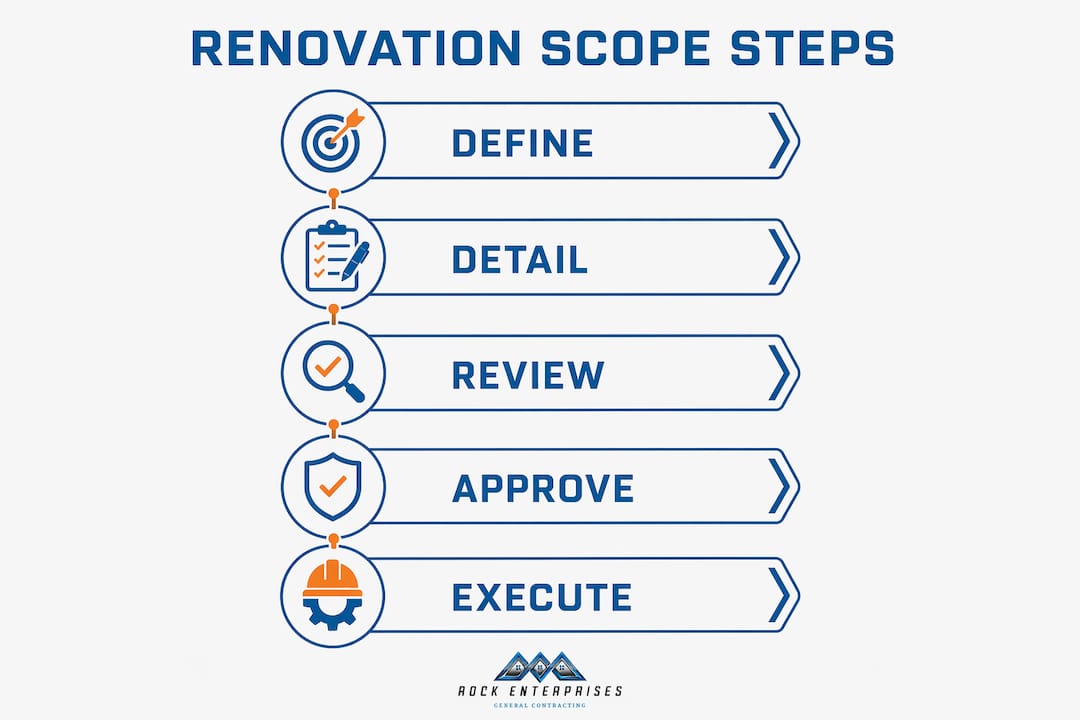
Step-by-step:
- Define your project goals broadly. Write a one-paragraph summary: what problem are you solving, what does success look like, and what is the non-negotiable outcome?
- Separate must-haves from nice-to-haves. This distinction shapes your budget and gives contractors room to offer alternatives without derailing the core project.
- Break work into trades and phases. List demolition, rough work (plumbing, electrical, HVAC), structural changes, insulation, drywall, finish carpentry, tile, painting, and final fixtures as separate line items.
- Specify materials precisely. “White subway tile” is not a specification. “Daltile Restore 3×6 Bright White ceramic tile, item #RE15” is. Include brand, model, size, color, and quantity wherever possible.
- Write your exclusions explicitly. If painting is not included, say so. If furniture moving is the homeowner’s responsibility, say so. Silence in a scope document leads contractors to assume items are included, which creates disputes and delays.
- State your constraints. Budget ceiling, hard completion date, HOA approval requirements, noise restrictions, and any access limitations all belong in the scope.
- Define acceptance criteria. What does “done” look like? Grout lines within 1/16 inch? No visible seams on countertops? Specify the standard, not just the task.
- Establish a change order process in writing before work starts. Verbal changes are the leading cause of payment conflicts in renovation projects. Agree on a written approval mechanism before the first nail goes in.
Pro Tip: Ask your contractor to review your draft scope and flag anything ambiguous or missing. Their markup often reveals assumptions you did not know you were making.
What a thorough renovation scope document actually contains
A complete renovation scope is built on six pillars. Each one prevents a specific category of dispute.
- Task descriptions: Detailed, trade-specific work items written in plain language. “Remove existing vanity, cap plumbing, install new 36-inch vanity per spec” beats “update bathroom.”
- Material specifications: Every product named with enough detail that a contractor cannot substitute a cheaper alternative without your knowledge. This is where brand names and model numbers earn their place.
- Explicit exclusions: The items deliberately left out. Common examples include asbestos abatement, unforeseen structural repairs, appliance delivery, and painting adjacent rooms. If it is not listed as included, list it as excluded.
- Project constraints: Budget cap, completion date, permit requirements, and any site-specific rules. These set the boundaries within which the contractor must operate.
- Acceptance criteria: The measurable or observable standards that define satisfactory completion for each phase. Without these, “done” is subjective.
- Change order procedures: The written process for requesting, pricing, approving, and documenting any deviation from the original scope. This single element prevents more disputes than any other part of the document.
When all six pillars are present, contractors bidding on your project are pricing the same job. That is the only way a bid comparison actually means something. Understanding the role of subcontractors in executing these tasks also helps you verify that the right trades are assigned to the right line items.
What renovation scope examples actually look like

A scope document is not a paragraph of prose. It is a structured list, often organized as a table or numbered outline. Here is what a typical kitchen and bathroom scope looks like in practice.
Kitchen renovation scope sample tasks:
- Demo existing cabinets, countertops, and backsplash tile; haul debris off-site
- Install new base and wall cabinets per approved layout drawing
- Supply and install quartz countertops (Silestone Calacatta Gold, 3cm, eased edge)
- Install undermount stainless steel sink and Delta Trinsic pull-down faucet
- Tile backsplash with specified 4×12 white ceramic tile in running bond pattern
- Rough plumbing: relocate dishwasher drain and supply lines per new layout
- Electrical: add dedicated 20A circuit for microwave; install under-cabinet lighting
- Exclusions: painting walls, appliance purchase, appliance installation
Bathroom renovation scope sample tasks:
- Demo existing tile floor and tub surround; remove vanity and toilet
- Install Schluter Kerdi waterproofing membrane on shower walls and floor
- Tile shower walls with 12×24 porcelain tile per spec; floor with 2×2 mosaic
- Install new 60-inch freestanding tub per owner selection
- Supply and install Kohler Memoirs toilet, elongated, comfort height
- Vanity: install 48-inch double-sink vanity per spec with quartz top
- Exclusions: exhaust fan replacement, painting, towel bar installation
| Scope Section | Typical Content |
|---|---|
| Demolition | Items removed, disposal method, protection of adjacent surfaces |
| Rough work | Plumbing, electrical, HVAC changes by licensed trade |
| Waterproofing | Membrane type, coverage area, inspection point |
| Materials | Brand, model, size, color, quantity for every product |
| Installation | Method, pattern, adhesive type, grout spec |
| Exclusions | Explicit list of out-of-scope items |
| Acceptance criteria | Quality standard and sign-off requirement per phase |
Templates like this keep you from forgetting a category. Customize every line to your specific project; a generic template left unchanged is only marginally better than no scope at all.
How Rock Enterprises approaches scope transparency
At Rockenterprisecontracting, every project starts with a detailed written scope before any pricing conversation happens. The owner is personally involved in that process, which means the scope reflects what the homeowner actually wants, not what is easiest to build.
A renovation scope is not paperwork for the contractor’s benefit. It is the homeowner’s single most powerful tool for staying in control of their project, their budget, and their expectations. When the scope is clear, everything else follows.
A few practices that make a real difference in scope clarity:
- Walk the space together. A site visit before drafting the scope surfaces conditions that drawings miss, like an out-of-plumb wall or a drain in an inconvenient location.
- Review the scope line by line with your contractor. Do not sign off on a document you have not read in full. Ask what every exclusion means for your project.
- Confirm permit requirements before finalizing. Some scope items trigger inspections; knowing that upfront prevents schedule surprises mid-project.
- Keep a copy of the signed scope on-site. When questions arise during construction, the scope is the reference, not a phone call.
Rockenterprisecontracting’s 5.0-star rating on Thumbtack reflects what happens when scope clarity and owner involvement are treated as non-negotiable from day one.
Rockenterprisecontracting brings your renovation scope to life
Knowing what a renovation scope should contain is one thing. Having a licensed contractor who builds one with you, line by line, before a single tool comes out is another.

Rockenterprisecontracting is a family-owned general contracting company based in Shrewsbury, NJ, serving Monmouth and Ocean County homeowners with kitchen remodels, bathroom renovations, and expert tile work. The owner personally oversees every project, which means the scope you agree to is the scope that gets built. No internal shorthand, no vague line items, no surprises at invoice time.
If you are planning a kitchen remodel or want to see the quality of work that a detailed scope produces, browse the project portfolio and reach out for a consultation. The scope conversation starts before the estimate, and that is exactly how it should be.
Key Takeaways
A renovation scope is the written foundation that keeps your project on budget, on schedule, and free of disputes.
| Point | Details |
|---|---|
| Scope vs. estimate | An estimate predicts cost; the scope defines precisely what that cost covers. |
| Six essential pillars | Tasks, material specs, exclusions, constraints, acceptance criteria, and change order process. |
| Explicit exclusions matter | Unlisted items are often assumed included by contractors, causing costly disputes. |
| Scope drives bid accuracy | Identical scopes let you compare contractor bids on equal terms. |
| Rockenterprisecontracting | Owner-led, transparent scope process for kitchen and bathroom renovations in Monmouth and Ocean County, NJ. |
FAQ
What is a renovation scope?
A renovation scope is a detailed, written document that defines every task, material, exclusion, and procedure involved in a remodeling project. It serves as the mutual agreement between homeowner and contractor on what will and will not be done.
How is a renovation scope different from a contract?
The scope of work is typically a section within the broader renovation contract. The contract covers payment terms, warranties, and legal obligations; the scope specifies the actual work to be performed.
What happens if you start a renovation without a scope?
Without a written scope, contractors and homeowners often operate on different assumptions about what is included. This leads to unexpected charges, disputes over quality, and delays when disagreements arise mid-project.
What should always be listed as an exclusion in a renovation scope?
Items commonly excluded include asbestos abatement, unforeseen structural repairs, appliance purchase or delivery, painting of adjacent rooms, and furniture moving. Listing these explicitly prevents contractors from assuming they are part of the job.
Can Rockenterprisecontracting help develop a renovation scope?
Yes. Rockenterprisecontracting works with homeowners in Monmouth and Ocean County, NJ to develop a clear, detailed scope before any pricing is finalized, so you know exactly what you are getting before work begins.